Advertisements
Advertisements
Action and reaction
(a) act on two different objects
(b) have equal magnitude
(c) have opposite directions
(d) have resultant zero.
Concept: undefined >> undefined
For most of the surfaces used in daily life, the friction coefficient is less than 1. Is it always necessary that the friction coefficient is less than 1?
Concept: undefined >> undefined
Advertisements
Why is it easier to push a heavy block from behind than to press it on the top and push?
Concept: undefined >> undefined
What is the average friction force when a person has a usual 1 km walk?
Concept: undefined >> undefined
Why is it difficult to walk on solid ice?
Concept: undefined >> undefined
Spring fitted doors close by themselves when released. You want to keep the door open for a long time, say for an hour. If you put a half kg stone in front of the open door, it does not help. The stone slides with the door and the door gets closed. However, if you sandwitch a 20 g piece of wood in the small gap between the door and the floor, the door stays open. Explain why a much lighter piece of wood is able to keep the door open while the heavy stone fails.
Concept: undefined >> undefined
A classroom demonstration of Newton's first law is as follows : A glass is covered with a plastic card and a coin is placed on the card. The card is given a quick strike and the coin falls in the glass. (a) Should the friction coefficient between the card and the coin be small or large? (b) Should the coin be light or heavy? (c) Why does the experiment fail if the card is gently pushed?
Concept: undefined >> undefined
Can a tug of war be ever won on a frictionless surface?
Concept: undefined >> undefined
Why do tyres have a better grip of the road while going on a level road than while going on an incline?
Concept: undefined >> undefined
You are standing with your bag in your hands, on the ice in the middle of a pond. The ice is so slippery that it can offer no friction. How can you come out of the ice?
Concept: undefined >> undefined
When two surfaces are polished, the friction coefficient between them decreases. But the friction coefficient increases and becomes very large if the surfaces are made highly smooth. Explain.
Concept: undefined >> undefined
While walking on ice, one should take small steps to avoid slipping. This is because smaller steps ensure.
Concept: undefined >> undefined
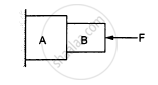
Consider the situation shown in figure. The wall smooth but the surface of A and B in contact are rough. The friction on B due to A in equilibrium
Concept: undefined >> undefined
A heavy box is kept on a smooth inclined plane and is pushed up by a force F acting parallel to the plane. Does the work done by the force F as the box goes from A to B depend on how fast the box was moving at A and B? Does the work by the force of gravity depend on this?
Concept: undefined >> undefined
Suppose all the surface in the previous problem are rough. The direction of friction of B due to A
Concept: undefined >> undefined
A spring-mass system oscillates with a frequency v. If it is taken in an elevator slowly accelerating upward, the frequency will
Concept: undefined >> undefined
A spring-mass system oscillates with a car. If the car accelerates on a horizontal road, the frequency of oscillation will
Concept: undefined >> undefined
A piece of wood is taken deep inside a long column of water and released. It will move up
Concept: undefined >> undefined
A solid sphere falls with a terminal velocity of 20 m s−1 in air. If it is allowed to fall in vacuum,
Concept: undefined >> undefined
A solid sphere moves at a terminal velocity of 20 m s−1 in air at a place where g = 9.8 m s−2. The sphere is taken in a gravity-free hall having air at the same pressure and pushed down at a speed of 20 m s−1.
(a) Its initial acceleration will be 9.8 m s−2 downward.
(b) It initial acceleration will be 9.8 m s−2 upward.
(c) The magnitude of acceleration will decrease as the time passes.
(d) It will eventually stop
Concept: undefined >> undefined
