Advertisements
Advertisements
A small spherical ball of radius 0.1 mm and density 104 kg m-3 falls freely under gravity through a distance of h before entering a tank of water. If, after entering the water the velocity of the ball does not change and it continues to fall with the same constant velocity inside the water, then the value of h will be ______ m.
(Given g = 10 ms-2, the viscosity of water = 1.0 × 10⁻⁵ N-sm-2).
Concept: undefined >> undefined
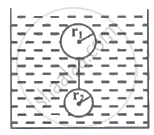
Two solid spherical balls of radius r1 and r2 (r2 < r1), of density σ are tied up with a long string and released in a viscous liquid column of lesser density ρ and coefficient of viscosity η, with the string just taut as shown. The terminal velocity of spheres is ______.
Concept: undefined >> undefined
Advertisements
If 'M' is the mass of water that rises in a capillary tube of radius 'r', then the mass of water which will rise in a capillary tube of radius '2r' is ______.
Concept: undefined >> undefined
Figure shows the vertical cross-section of a vessel filled with liquid of density ρ. The normal thrust per unit area on the walls of the vessel at point P, as shown will be:

Concept: undefined >> undefined
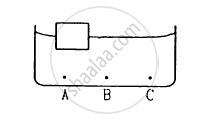
A wooden object floats in water kept in a beaker. The object is near a side of the beaker. Let P1, P2, P3 be the pressures at the three points A, B and C of bottom as shown in the figure.
Concept: undefined >> undefined
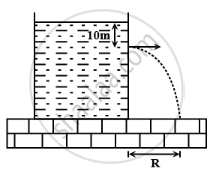
A large tank is filled with water (density = 103kg/m3). A small hole is made at a depth 10 m below water surface. The range of water effluxing out of the hole is R on ground. The extra pressure (in atm) must be applied on the water surface so that the range becomes 2R is ______. (Take 1 atm = 105 Pa and g = 10 m/s2)
Concept: undefined >> undefined
An ideal fluid is flowing in two pipes of same cross-sectional pipes area. Both the pipes are connected with two vertical tubes, of length h1 and h2 as shown in figure. The flow is stream line in both pipes. If velocity of fluid at A, B, and C are 2 m/s, 4 m/s and 4 m/s respectively, the velocity of fluid at D (in m/s) is ______.

Concept: undefined >> undefined
An ideal fluid flows (laminar flow) through a pipe of non-uniform diameter. The maximum and minimum diameters of the pipes are 6.4 cm and 4.8 cm, respectively. The ratio of the minimum and the maximum velocities of fluid in this pipe is ______.
Concept: undefined >> undefined
A solid metallic cube having a total surface area of 24 m2 is uniformly heated. If its temperature is increased by 10°C, calculate the increase in the volume of the cube.
(Given: α = 5.0 × 10⁻⁴°C-1)
Concept: undefined >> undefined
