Advertisements
Advertisements
A man is throwing bricks of mass 2 kg onto a floor from a height of 2 m. Bricks reach the floor at a speed `2sqrt(10)` m/s. Man throws 10 bricks in a minute. If the power of man is W watt then `3/10` W is equal to ______ W.
Concept: undefined >> undefined
If `vec"A" = (2hat"i"+3hat"j"- hat"k")`m and `vec"B" = (hat"i" + 2hat"j"+ 2hat"k")` m. The magnitude of component of vector `vec"A"` along vector `vec"B"` will be ______ m.
Concept: undefined >> undefined
Advertisements
A stone tide to a string of length L is whirled in a vertical circle with the other end of the string at the centre. At a certain instant of time, the stone is at its lowest position and has a speed u. The magnitude of change in its velocity, as it reaches a position where the string is horizontal, is `sqrt(x("u"^2 - "gL")`. The value of x is ______.
Concept: undefined >> undefined
Statement I: A cyclist is moving on an unbanked road with a speed of 7 kmh-1 and takes a sharp circular turn along a path of radius of 2 m without reducing the speed. The static friction coefficient is 0.2. The cyclist will not slip and pass the curve. (g = 9.8 m/s2)
Statement II: If the road is banked at an angle of 45°, cyclist can cross the curve of 2 m radius with the speed of 18.5 kmh-1 without slipping.
In the light of the above statements, choose the correct answer from the options given below.
Concept: undefined >> undefined
Which of the following statements is FALSE for a particle moving in a circle with a constant angular speed?
Concept: undefined >> undefined
Sand is being dropped from a stationary dropper at a rate of 0.5 kgs-1 on a conveyor belt moving with a velocity of 5 ms-1. The power needed to keep belt moving with the same velocity will be ______.
Concept: undefined >> undefined
A stone of mass 20 g is projected from a rubber catapult of length 0.1 m and an area of cross-section 10-6 m2 stretched by an amount of 0.04 m. The velocity of the projected stone is ______ m/s.
(Young's modulus of rubber = 0.5 × 10⁹ N/m2)
Concept: undefined >> undefined
A body is performing simple harmonic with an amplitude of 10 cm. The velocity of the body was tripled by air Jet when it is at 5 cm from its mean position. The new amplitude of vibration is `sqrtx` cm. The value of x is ______.
Concept: undefined >> undefined
If an emitter current is changed by 4 mA, the collector current changes by 3.5 mA. The value of β will be ______.
Concept: undefined >> undefined
Consider a mixture of gas molecule of types A, B and C having masses mA < mB < mC ratio of their root mean square speeds at normal temperature and pressure is ______.
Concept: undefined >> undefined
A rod of mass M and length L is lying on a horizontal frictionless surface. A particle of mass 'm' travelling along the surface hits at one end of the rod with velocity 'u' in a direction perpendicular to the rod. The collision is completely elastic. After collision, particle comes to rest. The ratio of masses `(m/M)` is `1/x`. The value of 'x' will be ______.
Concept: undefined >> undefined
A ball of mass 10 kg moving with a velocity of 10`sqrt3` ms–1 along the X-axis, hits another ball of mass 20 kg which is at rest. After collision, the first ball comes to rest and the second one disintegrates into two equal pieces. One of the pieces starts moving along Y-axis at a speed of 10 m/s. The second piece starts moving at a speed of 20 m/s at an angle θ (degree) with respect to the X-axis.
The configuration of pieces after the collision is shown in the figure.
The value of θ to the nearest integer is ______.
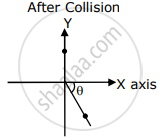
Concept: undefined >> undefined
Consider a 20 kg uniform circular disk of radius 0.2 m. It is pin supported at its center and is at rest initially. The disk is acted upon by a constant force F = 20 N through a massless string wrapped around its periphery as shown in the figure.
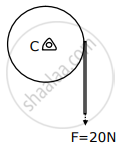
Suppose the disk makes n number of revolutions to attain an angular speed of 50 rad s–1. The value of n, to the nearest integer, is ________.
In one complete revolution, the disk rotates by 6.28 rad.
Concept: undefined >> undefined
A bead of mass m stays at point P(a, b) on a wire bent in the shape of a parabola y = 4Cx2 and rotating with angular speed ω (see figure). The value of ω is ______. (neglect friction)
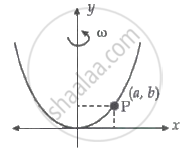
Concept: undefined >> undefined
The rms speeds of the molecules of Hydrogen, Oxygen, and Carbon dioxide at the same temperature are VH, VO, and `V_{CO_2}` respectively then ______.
Concept: undefined >> undefined
A particle of mass m with an initial velocity u`hat"i"` collides perfectly elastically with a mass 3m at rest. It moves with a velocity v`hat"j"` after collision, then, v is given by :
Concept: undefined >> undefined
A drunkard walking in a narrow lane takes 5 steps forward and 3 steps backward, followed again by 5 steps forward and 3 steps backward, and so on. Each step is 1 m long and required 1 s to cover. How long the drunkard takes to fall in a pit 13 m away from the start?
Concept: undefined >> undefined
A ball falls from a height of 1 m on a ground and it loses half its kinetic energy when it hits the ground. What would be the total distance covered by the ball after sufficiently long time?
Concept: undefined >> undefined
A ball is thrown upwards from the foot of a tower. The ball crosses the top of tower twice after an interval of 4 seconds and the ball reaches ground after 8 seconds, then the height of tower is ______ m. (g = 10 m/s2)
Concept: undefined >> undefined
A voltmeter of variable ranges 3 V, 15 V, 150 V is to be designed by connecting resistances R1, R2, R3 in series with a galvanometer of resistance G = 20 Ω, as shown in Fig. The galvanometer gives full pass through its coil for 1 mA current i.e. "gives full pass through it's coil for 1 mA current". Then, the resistances R1, R2 and R3 (in kilo ohms) should be, respectively:

Concept: undefined >> undefined
