Advertisements
Advertisements
The diagram represent the preparation and collection of hydrogen by a standard laboratory method.
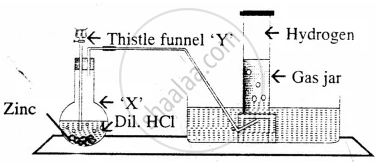
State, why hydrogen is collected after all the air in the apparatus, is allowed to escape.
Concept: undefined >> undefined
The diagram represent the preparation and collection of hydrogen by a standard laboratory method.
Name a gas other than hydrogen collected by the same method.
Concept: undefined >> undefined
Advertisements
The diagram represent the preparation and collection of hydrogen by a standard laboratory method.
Name a gas other than hydrogen collected by the same method.
Concept: undefined >> undefined
Explain why a hot saturated solution of potassium nitrate forms crystals as it cools.
Concept: undefined >> undefined
If you are given some copper sulphate crystals, how would you proceed to prepare its saturated solution at room temperature?
Concept: undefined >> undefined
How can you show that your solution is really saturated?
Concept: undefined >> undefined
Which test will you carry out to find out if a given solution is saturated or unsaturated or supersaturated?
Concept: undefined >> undefined
State the term:
When a substance absorbs moisture on exposure to moist air and dissolves in the absorbed water and turned to solution.
Concept: undefined >> undefined
When a substance absorbs moisture from the atmosphere but does not form a solution.
Concept: undefined >> undefined
Explain why:
A solution is always clear and transparent.
Concept: undefined >> undefined
State two ways by which a saturated solution can be changed to unsaturated solution.
Concept: undefined >> undefined
What is the nature of the charge on Anode rays?
Concept: undefined >> undefined
Why are anode rays also called as 'canal rays'?
Concept: undefined >> undefined
How does cathode ray differ from as anode rays?
Concept: undefined >> undefined
Which sub-atomic particle was discovered by Goldstein.
Concept: undefined >> undefined
Name the sub-atomic particle whose charge is +1.
Concept: undefined >> undefined
Complete the table given below by identifying P, Q, R and S.
|
Element |
Symbol |
No. of Protons |
No. of neutrons |
No. of Electrons |
|
Sodium |
`""_11^23"NA"` |
11 |
P |
11 |
|
Chlorine |
`""_17^35"CI"` |
Q |
18 |
17 |
|
Uranium |
R |
92 |
146 |
92 |
|
S |
`""_9^19"F"` |
9 |
10 |
9 |
Concept: undefined >> undefined
Write down the names of the particles represented by the following symbols and explain the meaning of superscript and subscript numbers attached `""_1"p"^1, ""_0"n"^1,""_-1"e"^0`
Concept: undefined >> undefined
What is the significance of the number of protons found in the atoms of different elements?
Concept: undefined >> undefined
Complete the table given below
|
|
No. of protons |
No. of electrons |
No. of Neutrons |
Atomic Number |
Mass number |
| `""_17^35"CI"` |
|
|
|
|
|
| `""_17^37"CI"` |
|
|
|
|
|
Concept: undefined >> undefined
