Advertisements
Advertisements
A uniform wire with a resistance of 27 Ω is divided into three equal pieces and then they are joined in parallel. Find the equivalent resistance of the parallel combination.
Concept: undefined >> undefined
A battery of e.m.f. 15 V and internal resistance 2 `Omega` is connected to tvvo resistors of 4 ohm and 6 ohm joined.
(i) In series,
(ii) In para 1 lel. Find in each case the electrica I energy spent per minute in 6 ohm resistor.
Concept: undefined >> undefined
Advertisements
Concept: undefined >> undefined
Show how would you connect three resistors, each of resistance 6 O so that
the combination has a resistance of(a) 9 Ω (b) 4 .Ω
Concept: undefined >> undefined
What are the advantages of a parallel connection?
Concept: undefined >> undefined
Explain, why is the p.d. between the terminals of a storage battery less when it is supplying current than when it is on open circuit. A battery of e.m.f. 10 volts and internal resistance 2.5 ohms has two resistances of 50 ohms each connected to it. Calculate the power dissipated in each resistance
(a) When they are in series,
(b) When they are in parallel.
In each case calculate the power dissipated in the battery.
Concept: undefined >> undefined
Tick (✓) the correct choice among the following :
Consider two cases of two parallel current carrying conductors. Current in
th e same direction and currents in th e opposi te directions will produce
Concept: undefined >> undefined
A cell supplies a current of 1.2 A through two 2Ω resistors connected in parallel. When the resistors are connected in series, if supplies a current of 0.4 A. Calculate the internal resistance and e.m.f of the cell.
Concept: undefined >> undefined
The circuit diagram Fig shows three resistors 2 Ω, 4 Ω and R Ω connected to a battery of e.m.f. 2 V and internal resistance 3 Ω. If main current of 0.25 A flows through the circuit, find:
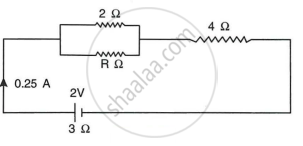
- the p.d. across the 4 Ω resistor,
- the p.d. across the internal resistance of the cell,
- the p.d. across the R Ω or 2 Ω resistors
- the value of R.
Concept: undefined >> undefined
Concept: undefined >> undefined
Concept: undefined >> undefined
Concept: undefined >> undefined
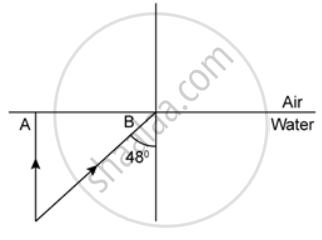
In the following figure, show two rays A and B travelling from water to air. If the critical angle for water- air surface is 48°, complete the ray diagram showing the refracted rays for each. State conditions when the ray will suffer total internal reflection.
Concept: undefined >> undefined
A lens forms the image of an object placed at a distance 15 cm from it, at a distance 60 cm in front of it. Find the focal length.
Concept: undefined >> undefined
A convex lens forms an inverted image of size same as that of the object which is placed at a distance 60 cm in front of the lens. Find:
- The position of the image, and
- The focal length of the lens.
Concept: undefined >> undefined
A concave lens forms an erect image of `1/3`rd the size of the object which is placed at a distance 30 cm in front of the lens. Find:
- the position of image, and
- the focal length of the lens.
Concept: undefined >> undefined
The focal length of a convex lens is 25 cm. Express its power with sign.
Concept: undefined >> undefined
The power of a lens is -2.0 D. Find its focal length and its kind.
Concept: undefined >> undefined
Describe how you would determine the focal length of a converging lens, using a plane mirror and one pin. Draw a ray diagram to illustrate your answer.
Concept: undefined >> undefined
The bells of a temple are big in size. Why?
Concept: undefined >> undefined
