Advertisements
Advertisements
A single fixed pulley is used because it ______.
Concept: undefined >> undefined
Make the correct choice for each of the following :
Which one of the five diagrams represents the path of a ray of light through a periscope?
Concept: undefined >> undefined
Advertisements
A uniform metre rule balances horizontally on a knife edge placed at the 58 cm mark when a weight of 20 gf is suspended from one end.
- Draw a diagram of the arrangement.
- What is the weight of the rule?
Concept: undefined >> undefined
The diagram in Fig. shows a uniform metre rule weighing 100 gf, pivoted at its centre O. Two weights 150 gf and 250 gf hang from the point A and B respectively of the metre rule such that OA = 40 cm and OB = 20 cm. Calculate :
- the total anticlockwise moment about O,
- the total clockwise moment about O,
- the difference of anticlockwise and clockwise moments, and
- the distance from O where a 100 gf weight should be placed to balance the metre rule.

Concept: undefined >> undefined
A uniform metre rule of weight 10 gf is pivoted at its 0 mark.
- What moment of force depresses the rule?
- How can it be made horizontal by applying a least force?
Concept: undefined >> undefined
A uniform half-metre rule can be balanced at the 29.0 cm mark when a mass of 20 g is hung from its one end.
- Draw a diagram of the arrangement.
- Find the mass of the half-metre rule.
- In which direction would the balancing point shift if 20 g mass is shifted inside from its one end?
Concept: undefined >> undefined
A uniform metre rule of mass 100g is balanced on a fulcrum at mark 40cm by suspending an unknown mass m at the mark 20cm. What is the resultant moment now?
Concept: undefined >> undefined
A uniform metre rule of mass 100g is balanced on a fulcrum at mark 40cm by suspending an unknown mass m at the mark 20cm.
How can it be balanced by another mass 50 g ?
Concept: undefined >> undefined
When an illuminated object is held in front of a thick plane glass mirror, several images are seen, out of which the second image is the brightest. Give reason.
Concept: undefined >> undefined
A beam of blue, green, and yellow light passes through the earth's atmosphere. Name the colour which is scattered the least.
Concept: undefined >> undefined
A beam of blue, green and yellow light passes through the earth's atmosphere. Name the colour which is scattered the most.
Concept: undefined >> undefined
Which colour of white light is scattered the least? Give reason.
Concept: undefined >> undefined
To an astronaut in a space-ship, the earth appears ______.
Concept: undefined >> undefined
A substance changes from its solid state to the liquid state when heat is supplied to it. How does the average kinetic energy of the molecules of the substance change?
Concept: undefined >> undefined
A radioactive source emits three types of radiations.
Name the three radiations.
Concept: undefined >> undefined
A radioactive source emits three types of radiations.
Name the radiations which are deflected by the electric field.
Concept: undefined >> undefined
The diagram in figure shows a radioactive source S placed in a thick lead walled container. The radiations given out are allowed to pass through a magnetic field. The magnetic field (shown as ×) acts perpendicular to the plane of paper inwards. Arrows shows the paths of the radiation A, B and C.
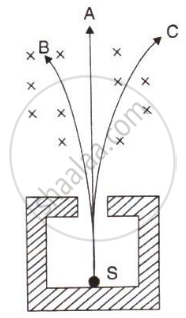
- Name the radiations labelled A, B and C.
- Explain clearly how you used the diagram to arrive at the answer in part (a).
Concept: undefined >> undefined
In following Figure shows a mixed source R of alpha and beta particles in a thick lead walled container. The particles pass through a magnetic field in a direction perpendicular to the plane of paper inwards as shown by ×.
- Show in the diagram how the particles get affected.
- Name the law used in part (a).
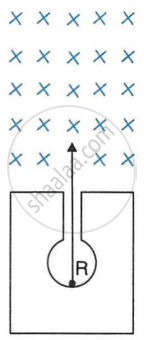
[Hint: Alpha particles will deflect to the left while beta particles to the right]
Concept: undefined >> undefined
In following Figure shows a radioactive source S in a thick lead walled container having a narrow opening. The radiations pass through an electric field between the plates A and B.
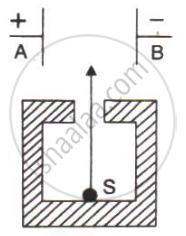
- Complete the diagram to show the paths of α, β and γ radiations.
- Why is the source S kept in a thick lead walled container with a narrow opening?
- Name the radiation which is unaffected by the electrostatic field.
- Which radiation is defleced the most. Given reason.
- Which among the three radiations causes the least biological damage?
Concept: undefined >> undefined
