Advertisements
Advertisements
A beam of α, β and γ rays is travelling through a certain region in space.
- Arrange them in ascending order of ionising power.
- Which of the above will pass undeviated if subjected to an electric field?
- With respect to your answer to part (b) above, what will be the change in the nucleus of an atom after such a ray is emitted.
Concept: undefined >> undefined
When the speed of a moving object is doubled, then its kenetic energy ______.
Concept: undefined >> undefined
Advertisements
A metal foot ruler is held at the edge of a table. It is pressed at its free end and then released. It vibrates.
- Name the vibrations produced.
- State one way to increase the frequency of these vibrations.
Concept: undefined >> undefined
A car of mass 120 kg is moving at a speed 18 km/h and it accelerates to attain a speed of 54 km/h in 5 seconds. Calculate:
- the work done by the engine.
- the power of the engine.
Concept: undefined >> undefined
Which nuclear radiation will travel undeviated in an electric field?
Concept: undefined >> undefined
Which of the following radiations suffer maximum deflection in a magnetic field?
Concept: undefined >> undefined
When a bell fixed on a cycle rings, then the energy conversion that takes place is ______.
Concept: undefined >> undefined
When a stone tied to a string is rotated in a horizontal plane, the tension in the string provides ______ force necessary for circular motion.
Concept: undefined >> undefined
A non uniform beam of weight 120 N pivoted at one end is shown in the diagram below. Calculate the value of F to keep the beam in equilibrium.
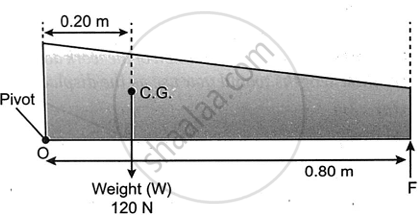
Concept: undefined >> undefined
The kinetic energy of a given body depends on the ______.
Concept: undefined >> undefined
If the mass as well as the velocity of a body is doubled then the kinetic energy of the body ______ the initial kinetic energy.
Concept: undefined >> undefined
O is a luminescent particle trapped inside a glass block. A student traces the path of rays coming out of it and reflecting over a plane mirror as shown in the diagram below.

Complete the table, using the labels from the figure. The first label is done for you.
| Sr. No. | Description | Label |
| a. | An angle of reflection on the mirror | a |
| b. | A partially reflected ray in the glass slab | |
| c. | A critical angle | |
| d. | A refracted ray | |
| e. | An angle of refraction of the ray R |
Concept: undefined >> undefined
What mass of ice at 0°C added to 2.1 kg water, will cool it down from 75°C to 25°C? Given Specific heat capacity of water = 4.2 Jg-1 °C-1, Specific latent heat of ice = 336 Jg-1.
Concept: undefined >> undefined
Find the kinetic energy of a body of mass 5 kg moving with a uniform velocity of 10 m s-1.
Concept: undefined >> undefined
A ball of mass 0.5 kg slows down from a speed of 10 m s−1 to that of 6 m s−1. Calculate the change in the kinetic energy of the ball.
Concept: undefined >> undefined
A tuning fork is vibrating in air. State whether the vibrations are natural or damped?
Concept: undefined >> undefined
The figure below shows a dual control switch circuit use to light a bulb.

- Complete the circuit so that bulb is switched on.
- Mark the supply terminals with L and N to indicate live and neutral wires.
Concept: undefined >> undefined
Arrange the α, β and γ radiations in ascending order of their penetrating power.
Concept: undefined >> undefined
Give one example of static equilibrium.
Concept: undefined >> undefined
