मराठी

Science (English Medium) इयत्ता ११ - CBSE Question Bank Solutions for Chemistry

Advertisements
[object Object]
[object Object]
विषय
मुख्य विषय
अध्याय
Advertisements
Advertisements
Chemistry
< prev  801 to 820 of 1673  next > 

Dehydration of hydrates of halides of calcium, barium and strontium i.e., CaCl26H2O, BaCl2.2H2O, SrCl2.2H2O, can be achieved by heating. These become wet on keeping in air. Which of the following statements is correct about these halides?

[10] S-block Elements (Alkali and Alkaline Earth Metals)
Chapter: [10] S-block Elements (Alkali and Alkaline Earth Metals)
Concept: undefined >> undefined

Several sodium compounds find use in industries. Which of the following compounds are used for textile industry?

(i) Na2CO3

(ii) NaHCO3

(iii) NaOH

(iv) NaCl

[10] S-block Elements (Alkali and Alkaline Earth Metals)
Chapter: [10] S-block Elements (Alkali and Alkaline Earth Metals)
Concept: undefined >> undefined

Advertisements

Match the elements given in Column I with the properties mentioned in Column II.

Column I Column II
(i) Li (a) Insoluble sulphate
(ii) Na (b) Strongest monoacidic base
(iii) Ca (c) Most negative EΘ value among alkali metals.
(iv) Ba (d) Insoluble oxalate
  (e) 6s2 outer electronic configuration
[10] S-block Elements (Alkali and Alkaline Earth Metals)
Chapter: [10] S-block Elements (Alkali and Alkaline Earth Metals)
Concept: undefined >> undefined

When water is added to compound (A) of calcium, solution of compound (B) is formed. When carbon dioxide is passed into the solution, it turns milky due to the formation of compound (C). If excess of carbon dioxide is passed into the solution milkiness disappears due to the formation of compound (D). Identify the compounds A, B, C and D. Explain why the milkiness disappears in the last step.

[10] S-block Elements (Alkali and Alkaline Earth Metals)
Chapter: [10] S-block Elements (Alkali and Alkaline Earth Metals)
Concept: undefined >> undefined

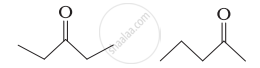
In which of the following, functional group isomerism is not possible?

[8] Organic Chemistry - Some Basic Principles and Techniques
Chapter: [8] Organic Chemistry - Some Basic Principles and Techniques
Concept: undefined >> undefined

Which of the following pairs are position isomers?

I. \[\begin{array}{cc}
\phantom{.......................}\ce{O}\\
\phantom{.......................}||\\
\ce{CH3 - CH2 - CH2 - CH2 - C - H}
\end{array}\]
II. \[\begin{array}{cc}
\phantom{.................}\ce{O}\\
\phantom{.................}||\\
\ce{CH3 - CH2 - CH2 - C - H}
\end{array}\]
III. \[\begin{array}{cc}
\ce{CH3 - CH2 - C - CH2 - CH3}\\
\phantom{}||\\
\phantom{}\ce{O}
\end{array}\]
IV. \[\begin{array}{cc}
\ce{CH3 - CH - CH2 - C - H}\\
\phantom{...}|\phantom{............}||\phantom{}\\
\phantom{...}\ce{CH3}\phantom{.........}\ce{O}\phantom{}
\end{array}\]

(i) I and II

(ii) II and III

(iii) II and IV

(iv) III and IV

[8] Organic Chemistry - Some Basic Principles and Techniques
Chapter: [8] Organic Chemistry - Some Basic Principles and Techniques
Concept: undefined >> undefined

Which of the following pairs are not functional group isomers?

I. \[\begin{array}{cc}
\phantom{.......................}\ce{O}\\
\phantom{.......................}||\\
\ce{CH3 - CH2 - CH2 - CH2 - C - H}
\end{array}\]
II. \[\begin{array}{cc}
\phantom{.................}\ce{O}\\
\phantom{.................}||\\
\ce{CH3 - CH2 - CH2 - C - H}
\end{array}\]
III. \[\begin{array}{cc}
\ce{CH3 - CH2 - C - CH2 - CH3}\\
\phantom{}||\\
\phantom{}\ce{O}
\end{array}\]
IV. \[\begin{array}{cc}
\ce{CH3 - CH - CH2 - C - H}\\
\phantom{...}|\phantom{............}||\phantom{}\\
\phantom{...}\ce{CH3}\phantom{.........}\ce{O}\phantom{}
\end{array}\]

(i) II and III

(ii) II and IV

(iii) I and IV

(iv) I and II

[8] Organic Chemistry - Some Basic Principles and Techniques
Chapter: [8] Organic Chemistry - Some Basic Principles and Techniques
Concept: undefined >> undefined

Consider structures I to VII and answer the question:

I. CH3 – CH2 – CH2 – CH2 – OH
II. \[\begin{array}{cc}
\ce{CH3 - CH2 - CH - CH3}\\
\phantom{.....}|\\
\phantom{.......}\ce{OH}
\end{array}\]
III. \[\begin{array}{cc}
\phantom{...}\ce{CH3}\\
\phantom{}|\\
\ce{CH3 - C - CH3}\\
\phantom{}|\\
\phantom{..}\ce{OH}
\end{array}\]
IV. \[\begin{array}{cc}
\ce{CH3 - CH - CH2 - OH}\\
|\phantom{........}\\
\ce{CH3}\phantom{......}
\end{array}\]
V. CH3 – CH2 – O – CH2 – CH3
VI. CH3 – O – CH2 – CH2 – CH3
VII. \[\begin{array}{cc}
\ce{CH3 - O - CH - CH3}\\
\phantom{...}|\\
\phantom{......}\ce{CH3}
\end{array}\]

Identify the pairs of compounds which are functional group isomers.

[8] Organic Chemistry - Some Basic Principles and Techniques
Chapter: [8] Organic Chemistry - Some Basic Principles and Techniques
Concept: undefined >> undefined

Consider structures I to VII and answer the question:

I. CH3 – CH2 – CH2 – CH2 – OH
II. \[\begin{array}{cc}
\ce{CH3 - CH2 - CH - CH3}\\
\phantom{.....}|\\
\phantom{.......}\ce{OH}
\end{array}\]
III. \[\begin{array}{cc}
\phantom{...}\ce{CH3}\\
\phantom{}|\\
\ce{CH3 - C - CH3}\\
\phantom{}|\\
\phantom{..}\ce{OH}
\end{array}\]
IV. \[\begin{array}{cc}
\ce{CH3 - CH - CH2 - OH}\\
|\phantom{........}\\
\ce{CH3}\phantom{......}
\end{array}\]
V. CH3 – CH2 – O – CH2 – CH3
VI. CH3 – O – CH2 – CH2 – CH3
VII. \[\begin{array}{cc}
\ce{CH3 - O - CH - CH3}\\
\phantom{...}|\\
\phantom{......}\ce{CH3}
\end{array}\]

Identify the pairs of compounds that represents position isomerism.

[8] Organic Chemistry - Some Basic Principles and Techniques
Chapter: [8] Organic Chemistry - Some Basic Principles and Techniques
Concept: undefined >> undefined

Consider structures I to VII and answer the question:

I. CH3 – CH2 – CH2 – CH2 – OH
II. \[\begin{array}{cc}
\ce{CH3 - CH2 - CH - CH3}\\
\phantom{.....}|\\
\phantom{.......}\ce{OH}
\end{array}\]
III. \[\begin{array}{cc}
\phantom{...}\ce{CH3}\\
\phantom{}|\\
\ce{CH3 - C - CH3}\\
\phantom{}|\\
\phantom{..}\ce{OH}
\end{array}\]
IV. \[\begin{array}{cc}
\ce{CH3 - CH - CH2 - OH}\\
|\phantom{........}\\
\ce{CH3}\phantom{......}
\end{array}\]
V. CH3 – CH2 – O – CH2 – CH3
VI. CH3 – O – CH2 – CH2 – CH3
VII. \[\begin{array}{cc}
\ce{CH3 - O - CH - CH3}\\
\phantom{...}|\\
\phantom{......}\ce{CH3}
\end{array}\]

Identify the pairs of compounds that represents chain isomerism.

[8] Organic Chemistry - Some Basic Principles and Techniques
Chapter: [8] Organic Chemistry - Some Basic Principles and Techniques
Concept: undefined >> undefined

Compounds with same molecular formula but differing in their structures are said to be structural isomers. What type of structural isomerism is shown by

CH3 – S – CH2 – CH2 – CH3

And 

\[\begin{array}{cc}
\phantom{.....................}\ce{CH3}\\
\phantom{................}/\\
\phantom{}\ce{CH3 - S - CH}\\
\phantom{...............}\backslash\\
\phantom{....................}\ce{CH3}
\end{array}\]

[8] Organic Chemistry - Some Basic Principles and Techniques
Chapter: [8] Organic Chemistry - Some Basic Principles and Techniques
Concept: undefined >> undefined

Assertion (A): Pent- 1- ene and pent- 2- ene are position isomers.

Reason (R): Position isomers differ in the position of functional group or a substituent.

[8] Organic Chemistry - Some Basic Principles and Techniques
Chapter: [8] Organic Chemistry - Some Basic Principles and Techniques
Concept: undefined >> undefined

The molecules having dipole moment are:

(i) 2,2-Dimethylpropane

(ii) trans-Pent-2-ene

(iii) cis-Hex-3-ene

(iv) 2, 2, 3, 3 - Tetramethylbutane.

[8] Organic Chemistry - Some Basic Principles and Techniques
Chapter: [8] Organic Chemistry - Some Basic Principles and Techniques
Concept: undefined >> undefined

Assertion (A): The compound cyclooctane has the following structural formula:

It is cyclic and has conjugated 8π-electron system but it is not an aromatic compound.

Reason (R): (4n + 2)π electrons rule does not hold good and ring is not planar.

[8] Organic Chemistry - Some Basic Principles and Techniques
Chapter: [8] Organic Chemistry - Some Basic Principles and Techniques
Concept: undefined >> undefined

During an educational trip, a student of botany saw a beautiful lake in a village. She collected many plants from that area. She noticed that villagers were washing clothes around the lake and at some places waste material from houses was destroying its beauty. After few years, she visited the same lake again. She was surprised to find that the lake was covered with algae, stinking smell was coming out and its water had become unusable. Can you explain the reason for this condition of the lake?

[14] Environmental Chemistry
Chapter: [14] Environmental Chemistry
Concept: undefined >> undefined

What are the major differences between metals and non-metals?

[3] Classification of Elements and Periodicity in Properties
Chapter: [3] Classification of Elements and Periodicity in Properties
Concept: undefined >> undefined

Considering the elements B, Al, Mg, and K, the correct order of their metallic character is ______.

[3] Classification of Elements and Periodicity in Properties
Chapter: [3] Classification of Elements and Periodicity in Properties
Concept: undefined >> undefined

Considering the elements B, C, N, F, and Si, the correct order of their non-metallic character is:

[3] Classification of Elements and Periodicity in Properties
Chapter: [3] Classification of Elements and Periodicity in Properties
Concept: undefined >> undefined

A student forgot to add the reaction mixture to the round-bottomed flask at 27 °C but instead, he/she placed the flask on the flame. After a lapse of time, he realized his mistake and using a pyrometer he found the temperature of the flask was 477 °C. What fraction of air would have been expelled out?

[5] States of Matter:- Gases and Liquids
Chapter: [5] States of Matter:- Gases and Liquids
Concept: undefined >> undefined

In terms of Charles’ law explain why - 273°C is the lowest possible temperature.

[5] States of Matter:- Gases and Liquids
Chapter: [5] States of Matter:- Gases and Liquids
Concept: undefined >> undefined
< prev  801 to 820 of 1673  next > 
Advertisements
Advertisements
CBSE Science (English Medium) इयत्ता ११ Question Bank Solutions
Question Bank Solutions for CBSE Science (English Medium) इयत्ता ११ Biology
Question Bank Solutions for CBSE Science (English Medium) इयत्ता ११ Chemistry
Question Bank Solutions for CBSE Science (English Medium) इयत्ता ११ Computer Science (C++)
Question Bank Solutions for CBSE Science (English Medium) इयत्ता ११ Computer Science (Python)
Question Bank Solutions for CBSE Science (English Medium) इयत्ता ११ English Core
Question Bank Solutions for CBSE Science (English Medium) इयत्ता ११ English Elective - NCERT
Question Bank Solutions for CBSE Science (English Medium) इयत्ता ११ Entrepreneurship
Question Bank Solutions for CBSE Science (English Medium) इयत्ता ११ Geography
Question Bank Solutions for CBSE Science (English Medium) इयत्ता ११ Hindi (Core)
Question Bank Solutions for CBSE Science (English Medium) इयत्ता ११ Hindi (Elective)
Question Bank Solutions for CBSE Science (English Medium) इयत्ता ११ History
Question Bank Solutions for CBSE Science (English Medium) इयत्ता ११ Mathematics
Question Bank Solutions for CBSE Science (English Medium) इयत्ता ११ Physics
Question Bank Solutions for CBSE Science (English Medium) इयत्ता ११ Political Science
Question Bank Solutions for CBSE Science (English Medium) इयत्ता ११ Psychology
Question Bank Solutions for CBSE Science (English Medium) इयत्ता ११ Sanskrit (Core)
Question Bank Solutions for CBSE Science (English Medium) इयत्ता ११ Sanskrit (Elective)
Question Bank Solutions for CBSE Science (English Medium) इयत्ता ११ Sociology
Share
Notifications

Englishहिंदीमराठी


      Forgot password?
Use app×