Advertisements
Advertisements
Write IUPAC name of the following compound:
CH3CH = C(CH3)2
Concept: undefined >> undefined
In the alkane H3C–CH2–C(CH3)2–CH2–CH(CH3)2, identify 1°,2°,3° carbon atoms and give the number of H atoms bonded to each one of these.
Concept: undefined >> undefined
Advertisements
Write structures of all the alkenes which on hydrogenation give 2-methylbutane.
Concept: undefined >> undefined
A sample of pure PCl5 was introduced into an evacuated vessel at 473 K. After equilibrium was attained, the concentration of PCl5 was found to be 0.5 × 10⁻¹ mol L–1. If the value of Kc is 8.3 × 10⁻³, what are the concentrations of PCl3 and Cl2 at equilibrium?
\[\ce{PCl5 (g) ⇌ PCl3 (g) + Cl2(g)}\]
Concept: undefined >> undefined
At 1127 K and 1 atm pressure, a gaseous mixture of CO and CO2 in equilibrium with solid carbon has 90.55% CO by mass
\[\ce{C (s) + CO2 (g) ⇌ 2CO (g)}\]
Calculate Kc for this reaction at the above temperature.
Concept: undefined >> undefined
For the following bond cleavages, use curved arrows to show the electron flow and classify homolysis or heterolysis. Identify reactive intermediate produced as free radical, carbocation and carbanion.
\[\ce{CH3O - OCH3 -> CH3\overset\bullet{\text{O}} + \overset\bullet{\text{O}}CH3}\]
Concept: undefined >> undefined
For the following bond cleavages, use curved-arrows to show the electron flow and classify as homolysis or heterolysis. Identify reactive intermediate produced as free radical, carbocation and carbanion.

Concept: undefined >> undefined
For the following bond cleavages, use curved-arrows to show the electron flow and classify as homolysis or heterolysis. Identify reactive intermediate produced as free radical, carbocation and carbanion.
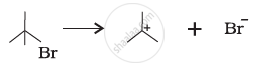
Concept: undefined >> undefined
For the following bond cleavages, use curved-arrows to show the electron flow and classify as homolysis or heterolysis. Identify reactive intermediate produced as free radical, carbocation and carbanion.
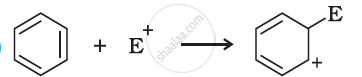
Concept: undefined >> undefined
Which of the following carbocation is most stable?
Concept: undefined >> undefined
The equilibrium constant for the following reaction is 1.6 ×10⁵ at 1024K
\[\ce{H2(g) + Br2(g) ⇌ 2HBr(g)}\]
Find the equilibrium pressure of all gases if 10.0 bar of HBr is introduced into a sealed container at 1024K.
Concept: undefined >> undefined
Describe the structure of the common form of ice.
Concept: undefined >> undefined
Among the elements \[\ce{B, Al, C}\] and \[\ce{Si}\], which element has the most metallic character?
Concept: undefined >> undefined
Arrange the elements \[\ce{N, P, O}\] and \[\ce{S}\] in the order of increasing non metallic character. Give reason for the arrangement assigned.
Concept: undefined >> undefined
Among alkali metals which element do you expect to be least electronegative and why?
Concept: undefined >> undefined
What is meant by the term average bond enthalpy? Why is there difference in bond enthalpy of \[\ce{O - H}\] bond in ethanol \[\ce{(C2H5OH)}\] and water?
Concept: undefined >> undefined
The variation of pressure with volume of the gas at different temperatures can be graphically represented as shown in figure.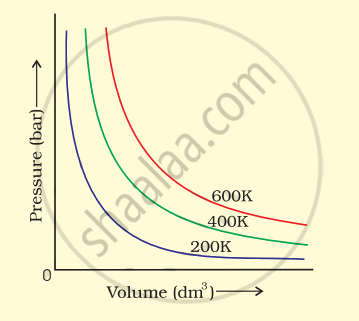
On the basis of this graph answer the following questions.
(i) How will the volume of a gas change if its pressure is increased at constant temperature?
(ii) At a constant pressure, how will the volume of a gas change if the temperature is increased from 200 K to 400 K?
Concept: undefined >> undefined
Match the following gas laws with the equation representing them.
| (i) Boyle's law | (a) `V oo n` at constant T and p |
| (ii) Charle's law | (b) PTotal = p1 + p2 + p3 + at constant T, V |
| (iii) Dalton's law | (c) `(pV)/T` = Constant T |
| (iv) Avogadro law | (d) `V oo T` at constant n and p |
| (e) `P oo 1/V` at constant n and T |
Concept: undefined >> undefined
We know that the relationship between Kc and Kp is Kp = Kc (RT)∆n What would be the value of ∆n for the reaction \[\ce{NH4Cl (s) ⇌ NH3 (g) + HCl (g)}\]
Concept: undefined >> undefined
Why do beryllium and magnesium not impart colour to the flame in the flame test?
Concept: undefined >> undefined
