Advertisements
Advertisements
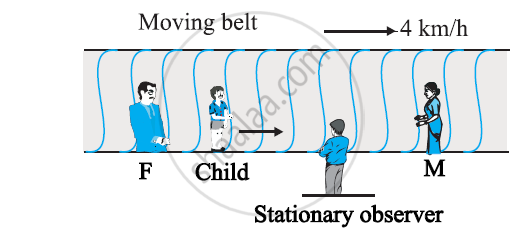
On a long horizontally moving belt (Fig. 3.26), a child runs to and fro with a speed 9 km h–1 (with respect to the belt) between his father and mother located 50 m apart on the moving belt. The belt moves with a speed of 4 km h–1. For an observer on a stationary platform outside, what is the
(a) speed of the child running in the direction of motion of the belt ?.
(b) speed of the child running opposite to the direction of motion of the belt ?
(c) time taken by the child in (a) and (b) ?
Which of the answers alter if motion is viewed by one of the parents?
Concept: undefined >> undefined
If a particle is accelerating, it is either speeding up or speeding down. Do you agree with this statement?
Concept: undefined >> undefined
Advertisements
Give example where the velocity of a particle is zero but its acceleration is not zero.
Concept: undefined >> undefined
Give example where the velocity is opposite in direction to the acceleration.
Concept: undefined >> undefined
Give example where the velocity is perpendicular to the acceleration.
Concept: undefined >> undefined
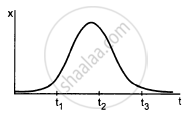
In figure shows the x coordinate of a particle as a function of time. Find the sings of vx and ax at t = t1, t = t2 and t = t3.
Concept: undefined >> undefined
A stone is released from an elevator going up with an acceleration a. The acceleration of the stone after the release is
Concept: undefined >> undefined
The accelerations of a particle as seen from two frames S1 and S2 have equal magnitude 4 m/s2.
Concept: undefined >> undefined
An object having a velocity 4.0 m/s is accelerated at the rate of 1.2 m/s2 for 5.0 s. Find the distance travelled during the period of acceleration.
Concept: undefined >> undefined
What can be said about the centre of mass of a uniform hemisphere without making any calculation? Will its distance from the centre be more than r/2 or less than r/2?
Concept: undefined >> undefined
A uniform sphere is placed on a smooth horizontal surface and a horizontal force F is applied on it at a distance h above the surface. The acceleration of the centre
Concept: undefined >> undefined
A heavy ring of mass m is clamped on the periphery of al light circular disc. A small particle having equal mass is clamped at the centre of the disc. The system is rotated in such a way that the centre moves in a circle of radius r with a uniform speed v. We conclude that an external force
Concept: undefined >> undefined
A uniform disc of radius R is put over another uniform disc of radius 2R of the same thickness and density. The peripheries of the two discs touch each other. Locate the centre of mass of the system.
Concept: undefined >> undefined
A disc of radius R is cut out from a larger disc of radius 2R in such a way that the edge of the hole touches the edge of the disc. Locate the centre of mass of the residual disc.
Concept: undefined >> undefined
One end of a uniform rod of mass m and length l is clamped. The rod lies on a smooth horizontal surface and rotates on it about the clamped end at a uniform angular velocity \[\omega\] The force exerted by the clamp on the rod has a horizontal component
Concept: undefined >> undefined
A uniform rod is kept vertically on a horizontal smooth surface at a point O. If it is rotated slightly and released, it falls down on the horizontal surface. The lower end will remain _________ .
Concept: undefined >> undefined
A uniform chain of mass M and length L is held vertically in such a way that its lower end just touches the horizontal floor. The chain is released from rest in this position. Any portion that strikes the floor comes to test. Assuming that the chain does not form a heap on the floor calculate the force exerted by it on the floor when a length x has reached the floor.
Concept: undefined >> undefined
A rod of mass m and length L, lying horizontally, is free to rotate about a vertical axis through its centre. A horizontal force of constant magnitude F acts on the rod at a distance of L/4 from the centre. The force is always perpendicular to the rod. Find the angle rotated by the rod during the time t after the motion starts.
Concept: undefined >> undefined
A square plate of mass 120 g and edge 5⋅0 cm rotates about one of the edges. If it has a uniform angular acceleration of 0⋅2 rad/s2 what torque acts on the plate?
Concept: undefined >> undefined
Calculate the torque on the square plate of the previous problem if it rotates about a diagonal with the same angular acceleration.
Concept: undefined >> undefined
