Advertisements
Advertisements
On the given outline Political Map of India, identify the place marked as 'A' with the help of following information and write its correct name on the line marked near it:
The place where National Congress Session was held in September, 1920.

Concept: undefined >> undefined
Explain any three terms of Credit.
Concept: undefined >> undefined
Advertisements
"Foreign trade has been the main channel of connecting countries for a long time." Analyse the statement.
Concept: undefined >> undefined
Explain the role of Election Commission regarding recognition of Political Parties in India.
Concept: undefined >> undefined
Read the given source and answer the questions that follow:
|
DECENTRALISATION IN INDIA This new system of local government is the largest experiment in democracy conducted anywhere in the world. There are now about 36 lakh elected representatives in the panchayats and municipalities etc., all over the country. This number is bigger than the population of many countries in the world. Constitutional status for local government has helped to deepen democracy in our country. It has also increased women's representation and voice in our democracy. At the same time, there are many difficulties. while elections are held regularly of Panchayats and people participate enthusiastically in it but meetings of gram sabhas are not held regularly. |
- Why is Indian decentralisation considered as the largest experiment in democracy?
- Analyse how constitutional status for local government has helped to deepen democracy in India?
- Explain any two steps taken by the Indian Government for decentralisation.
Concept: undefined >> undefined
Explain any three institutional reforms taken for the development of Indian agriculture.
Concept: undefined >> undefined
Read the given source and answer the questions that follow:
|
RAINWATER HARVESTING Many thought that given the disadvantages and rising resistance against the multi purpose projects, water harvesting system was a viable alternative, both socio-economically and environinentally. In ancient India, along with the sophisticated hydraulic structures, there existed an extraordinary tradition of water harvesting system. People had in-depth knowledge of rainfall regimes and soil types and developed wide ranging techniques to harvest rainwater, groundwater, river water and flood water in keeping with the local ecological conditions and their water needs. In hill and mountainous regions, people built diversion channels like the 'guls' or 'kuls' of the Western Himalayas for agriculture. 'Rooftop rainwater harvesting' was commonly practised to store drinking water, particularly in Rajasthan. In the flood plams of Bengal, people developed inundation channels to irrigate their fields. In arid and semi-arid regions, agricultural fields were converted into rain fed storage structures that allowed the water to stand and moisten the soil like the 'khadins' in Jaisalmer and 'Johads' in other parts of Rajasthan. |
- Why is water harvesting system a viable alternative?
- Describe the process of 'rooftop rainwater harvesting.'
- Mention any two methods adopted by ancient India for water conservation.
Concept: undefined >> undefined
Mention any two changes that occurred in West Punjab in the 19th century.
Concept: undefined >> undefined
Analyse the characteristics of India's National Water Policy 2002.
Concept: undefined >> undefined
Analyse the main aims of 'Jal Kranti Abhiyan (2015-16) in India.
Concept: undefined >> undefined
Assertion (A): Democracies are based on political equality.
Reason (R): All individuals have equal say in electing representatives.
Concept: undefined >> undefined
Evaluate the impacts of opening foreign trade on the global economy by identifying the appropriate statements among the following options:
- The choice of goods in the markets increase.
- Producers from two countries closely compete against each other despite the distance between their locations.
- Foreign trade thus results in connecting the markets or integration of markets in different countries.
- The quality of the product is always good.
Concept: undefined >> undefined
Evaluate the significant distinction between the national and regional parties and assess the requirements for a regional party to become a national party.
Concept: undefined >> undefined
Two places A and B have been marked on the given outline map of India.
a) Identify them and write their correct names on the lines drawn near them.
- Indian National congress session at this place in 1920.
- The place where Mahatma Gandhi broke the salt law.
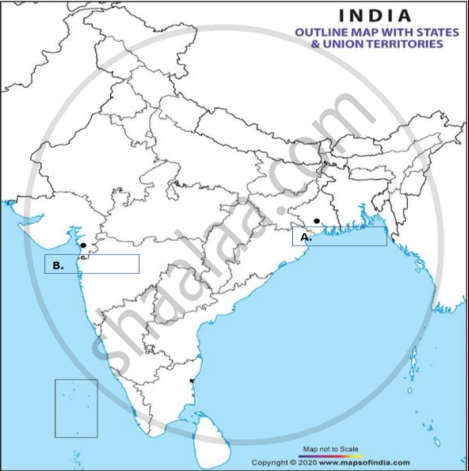
b) On the same outline map of India locate and label any 3 of the following with suitable symbols.
- A Coal mine in Tamil Nadu.
- A dam built on river Chenab in India.
- A largest natural major seaport located at Andhra Pradesh.
- Noida software technology park.
Concept: undefined >> undefined
Assertion (A): Banks are not ready to lend money to certain borrowers.
Reason (R): Some people do not have collateral.
Concept: undefined >> undefined
Why could different persons have different notions of a country’s development? Explain with examples.
Concept: undefined >> undefined
Which one of the following statements best describes the meaning of 'Globalisation'?
Concept: undefined >> undefined
"Activities in the private sector are guided by the motive to earn profits." Examine the statement with examples.
Concept: undefined >> undefined
How are industries the main source of water pollution?
Concept: undefined >> undefined
“Foreign trade results in connecting the markets in different countries.” Support the statement in the context of globalisation.
Concept: undefined >> undefined
