Advertisements
Advertisements
The maximum velocity of a particle performing linear S.H.M. is 0.16 m/s. If its maximum acceleration is 0.64 m/s2, calculate its period.
Concept: Differential Equation of Linear S.H.M.
The ratio of diameters of two wires of the same material and length is n : 1. If the same load is applied to both the wires then increases in the length of the thin wire is ........................ (n > 1).
- n1/4 times
- n1/2 times
- n times
- n2 times
Concept: Behaviour of Metal Wire Under Increasing Load
The buckling of a beam is found to be more if ___ .
(a) the breadth of the beam is large.
(b) the beam material has large value of Young's -modulus.
(c) the length of the beam is small.
(d) the depth of the beam is small.·
Concept: Hooke’s Law
Two particles perform linear simple harmonic motion along the same path of length 2A and period T as shown in the graph below. The phase difference between them is ___________.
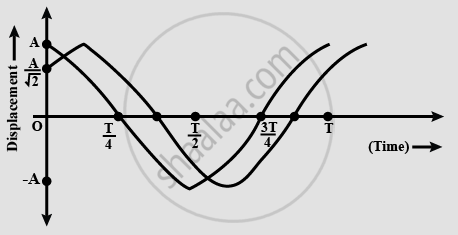
Concept: Differential Equation of Linear S.H.M.
A mass M attached to a spring oscillates with a period of 2 seconds. If the mass is increased by 2 Kg, the eriod increases by 1 second. Find the initial mass, assuming that Hooke's law is obeyed.
Concept: Hooke’s Law
A copper metal cube has each side of length 1 m. The bottom edge of the cube is fixed and tangential force 4.2x10⁸ N is applied to a top surface. Calculate the lateral displacement of the top surface if modulus of rigidity of copper is 14x1010 N/m2.
Concept: Periodic and Oscillatory Motion
Young’s modulus of material of wire is ‘Y’ and strain energy per unit volume is ‘E’, then the strain is
(A) `sqrtY/(2E)`
(B) `sqrt(E/Y)`
(C) `sqrt((2E)/Y)`
(D) `sqrt(2EY)`
Concept: Hooke’s Law
Stretching of a rubber band results in _______.
(A) no change in potential energy.
(B) zero value of potential energy.
(C) increase in potential energy.
(D) decrease in potential energy.
Concept: Elastic Energy
A mass of 1 kg is hung from a steel wire if radius 0.5 mm and length 4 m. Calculate the extension produced. What should be the area of cross-section of the wire so that elastic limit is not exceeded? Change in radius is negligible
(Given : g = 9.8 m/s2; Elastic limit of steel is 2.4 x 10⁸ N/m2;Y for steel (Ysteel) = 20 x 1010 N/m2; π = 3.142)
Concept: Behaviour of Metal Wire Under Increasing Load
Within the elastic limit, find the work done by a stretching force on a wire.
Concept: Elastic Energy
Define linear simple harmonic motion.
Concept: Linear Simple Harmonic Motion (S.H.M.)
Two wires of the same material have radii rA and rB respectively. The radius of wire A is twice the radius of wire B. If they are stretched by same load then stress on wire B is _______.
Concept: Eneral Explanation of Elastic Property
The S.I. unit of compressibility is __________.
Concept: Application of Elastic Behaviour of Materials
Answer in brief:
Derive an expression for the period of motion of a simple pendulum. On which factors does it depend?
Concept: Periodic and Oscillatory Motion
A particle executing linear S.H.M. has velocities v1 and v2 at distances x1 and x2 respectively from the mean position. The angular velocity of the particle is _______
Concept: Differential Equation of Linear S.H.M.
The compressibility of a substance is the reciprocal of _________.
(a) Young’s modulus
(b) bulk modulus
(c) modulus of rigidity
(d) Poisson's ratio
Concept: Eneral Explanation of Elastic Property
A particle performing linear S.H.M. has the maximum velocity of 25 cm/s and maximum acceleration of 100 cm/ m2. Find the amplitude and period of oscillation. (π = 3.142)
Concept: Differential Equation of Linear S.H.M.
The length of the second’s pendulum in a clock is increased to 4 times its initial length. Calculate the number of oscillations completed by the new pendulum in one minute.
Concept: Periodic and Oscillatory Motion
State Hooke’s law. Define the elastic limit and modulus of elasticity.
Concept: Hooke’s Law
