Advertisements
Advertisements
Explain the major components of government budget.
Concept: Types of Budget
In order to tackle the problem of rising general price in an economy, government may come up with a surplus budget to achieve the budget objective of ______.
- reallocation of resources
- price stability
- redistribution of income
Concept: Objectives of Government Budget
Assertion (A): The Balance of payments is in surplus, if autonomous receipts are greater than autonomous payments.
Reason (R): Autonomous transactions are determined by the difference in the Balance of Payments.
Concept: Concept of Balance of Payments >> Balance of Payments Surplus and Deficit
As per the Reserve Bank of India (RBI) press report, dated 22nd June, 2022:
"Net Foreign Portfolio Investment (FPI) recorded an outflow of US $15.2 billion mainly from the equity market."
The above transaction will be recorded in the ______ account on ______ side of Balance of payments account of India.
Concept: Concept of Balance of Payments >> Capital Account
'Deficit' in Balance of payment (BOP) refers to the excess of ______.
Concept: Concept of Balance of Payments >> Balance of Payments Surplus and Deficit
Suppose, the price of one UK Pound (£) has increased from ₹ 70 to ₹ 80, owing to market forces.
This means that value of Indian Currency (₹) has ______.
Concept: Determination of the Exchange Rate
Suppose, Country X, has more inflation than Country Y. Which of the following is most likely situation to happen in such a case, assuming other factors being constant?
Concept: Concept of Balance of Payments >> Balance of Payments Surplus and Deficit
An economy is in equilibrium. Find investment expenditure :
National income =1200
Autonomous consumption expenditure=150
Marginal Propensity to consume =0.8
Concept: Methods of Measurement of National Income >> Expenditure Method
Answer the following question.
Explain the meaning of opportunity cost with the help of a production possibility schedule.
Concept: Concepts of Production Possibility Frontier
What was the two-fold motive behind the systematic deindustrialisation effected by the British in pre-independent India?
Concept: India's Economy Before Independence
Choose the correct alternative from given options:
In the given figure, the movement on the production possibility curve from point A to point B shows _____________.
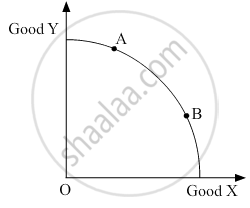
Concept: Concepts of Production Possibility Frontier
Identify and discuss the nature of the following newspaper reports in terms of positive or normative economic analysis:
(i) "India jumped 23 points in the World Bank's ease of doing business index to 77th place, highest in 2 years." – The Economic Times
(ii) "Government should further liberalise the business rules." – The Economic Times
Concept: Positive and Normative Economics
Answer the following question.
Gross Domestic Product (GDP) Does Not Give Us a Clear Indication of Economic Welfare of a Country. "Defend Or Refute the Given Statement with Valid Reason.
Concept: GDP and Welfare
Distinguish between positive externalities and negative externalities.
Concept: Factor Cost, Basic Prices and Market Prices
Discuss any two merits and demerits of the Green Revolution in the agricultural sector in the Indian economy.
Concept: Agriculture
State the meanings of the following:
Operating Surplus
Concept: Factor Cost, Basic Prices and Market Prices
Explain the role of microcredit in meeting credit requirements of the poor.
Concept: Credit and Marketing in Rural Areas
Distinguish between ‘Green Revolution’ and ‘Golden Revolution’.
Concept: Diversification into Productive Activities
"In India women participation rate is lower in urban areas than in the rural areas." Explain with valid arguments.
Concept: State of India’s Environment
“In rural areas of India more members of a family are engaged on work, yet the gross income of the family is generally low.”
Identify the type of unemployment indicated in the above statement and explain the paradox associated with it.
Concept: Concept of Unemployment
