Advertisements
Advertisements
State the law that explains the heating effect of current with respect to the measurable properties in an electrical circuit.
Concept: Heating Effect of Electric Current
Anannya responded to the question: Why do electrical appliances with metallic bodies are connected to the mains through a three-pin plug, whereas an electric bulb can be connected with a two-pin plug?
She wrote: Three-pin connections reduce heating of connecting wires.
- Is her answer correct or incorrect? Justify.
- What is the function of a fuse in a domestic circuit?
Concept: Heating Effect of Electric Current

Vinita and Ahmed demonstrated a circuit that operates the two headlights and the two sidelights of a car, in their school exhibition. Based on their demonstrated circuit, answer the following questions.
- State what happens when switch A is connected to:
a) Position 2
b) Position 3 - Find the potential difference across each lamp when lit.
- Calculate the current.
a) in each 12 Ω lamp when lit.
b) In each 4 Ω lamp when lit.
OR - Show, with calculations, which type of lamp, 4.0 Ω or 12 Ω, has the higher power.
Concept: Ohm's Law
Consider the following combinations of resistors:


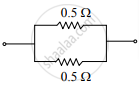
The combinations having equivalent resistance 1 Q is/are ______.
Concept: Resistance of a System of Resistors >> Resistors in Series
An electric iron of resistance 20 Ω draws a current of 5 A. The heat developed in the iron in 30 seconds is ______.
Concept: Heating Effect of Electric Current
How is Joule's law effect useful in electric circuits where fuse is used as a safety device?
Concept: Electric Circuit
Study the following circuit:

On the basis of this circuit, answer the following questions:
i. Find the value of total resistance between the points A and B.
ii. Find the resistance between the points B and C.
iii. Calculate the current drawn from the battery, when the key is closed
OR
iii. In the above circuit, the 16Ω resistor or the parallel combination of two resistors of 8 Ω, which one of the two will have more potential difference across its two ends? Justify your answer.
Concept: Resistance of a System of Resistors >> Resistors in Parallel
