Topics
Section A
Relations and Functions
- Fundamental Concepts of Ordered Pairs and Relations
- Types of Relations
- Equivalence Class and Relation
- Congruence Modulo
- Functions
- Real-Valued and Real Functions
- Types of Functions
- Composition of Functions
- Invertible Functions
- Binary Operations
- Overview of Relations and Functions
Inverse Trigonometric Functions
Section B
Section C
Matrices
Determinants
Continuity and Differentiability
Indeterminate Forms
Applications of Derivatives
Integrals
Differential Equations
Probability
Vectors
Three Dimensional Geometry
Applications of Integrals
Application of Calculus in Commerce and Economics
Linear Regression
Linear Programming
- Ways of Representing Functions
- Tabular Representation of a Function
- Graphical Representation of a Function
- Analytical Representation of a Function
- Some Elementary Functions
- Types of Functions
- Operations on Functions
- Inverse of a Function
- Algebra of Functions
- Some Special Functions
Definition
A relation f from a set A to a set B is said to be a function if every element of set A has one and only one image in set B.
A function which has either R or one of its subsets as its range is called a real valued function. Further, if its domain is also either R or a subset of R, it is called a real function.
Notes
In other words, a function f is a relation from a non-empty set A to a non-empty set B such that the domain of f is A and no two distinct ordered pairs in f have the same first element.
If f is a function from A to B and (a, b) ∈ f, then f (a) = b, where b is called the image of a under f and a is called the preimage of b under f.
The function f from A to B is denoted by f: A → B.
A funcion is a connection between 2 sets A and B f: A→B such that
1) All elements in A are associated to some element in B
2) This association is unique, that means one and only one.
Let's try to understand this with a simple anology,
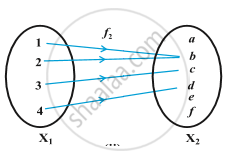
Here, let's say `"X"_1` is a set of all children and `"X"_2` is a set of all womens. And `"X"_1` and `"X"_2` have connection as mother and children.
So as per the definition there is a connention between 2 sets `"X"_1` and `"X"_2` such that all the elements of `"X"_1` are associated to some element in set `"X"_2` i.e all the childrens are related to a particualr mother, and this association is unique because no one child can have two or more mothers, but a mother can have more than one child.
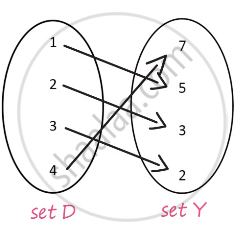
Consider the sets D and Y related to each ther as shown, clearly every element in the set D is related to exactly one element in the set Y. So the given relation is a function. f: D → Y.
Here, D is the domain of the function and Y is the co domain of the function.
f(1)= 5
Here, 5 is called the image of 1 under f and 1 is called preimage of 5 under f.
The range of this function is, Range= {2,3,5,7}
The range is a set of real numbers so the function is Real valued function.
