Advertisements
Chapters
1: Budgeting and Savings
2: Space Organisation in the Kitchen
3: Home Furnishings
UNIT 2: GROWTH AND DEVELOPMENT DURING MIDDLE CHILDHOOD
4: Milestones of Development
▶ 5: Role of Family, Peer Group and School
6: Learning Disabilities in Children
UNIT 3: MEAL PLANNING
7: Balanced Diet
8: Meal Planning for the Family
9: Storage and Preservation of Food
UNIT 4: SELECTION AND CARE OF TEXTILE AND CLOTHING
10: Selection of Fabrics
11: Selection of Readymade Garments
12: Laundry Material
13: Laundering
UNIT 5: COMMUNICATION AND EXTENSION
14: Social and Economic Issues in India
15: Role of Government Towards A Developed India
16: Communication Aids
![Dr. Alka Agarwal, Urvi Raval solutions for होम साइंस [अंग्रेजी] कक्षा १० आईसीएसई chapter 5 - Role of Family, Peer Group and School - Shaalaa.com](/images/home-science-english-class-10-icse_6:47f2a0e2bbf14b0390712d5a5fb6e473.jpg "Dr. Alka Agarwal, Urvi Raval solutions for होम साइंस [अंग्रेजी] कक्षा १० आईसीएसई chapter 5 - Role of Family, Peer Group and School")
Advertisements
Solutions for Chapter 5: Role of Family, Peer Group and School
Below listed, you can find solutions for Chapter 5 of CISCE Dr. Alka Agarwal for होम साइंस [अंग्रेजी] कक्षा १० आईसीएसई.
Dr. Alka Agarwal, Urvi Raval solutions for होम साइंस [अंग्रेजी] कक्षा १० आईसीएसई 5 Role of Family, Peer Group and School EXERCISES [Pages 71 - 75]
OBJECTIVE QUESTIONS Fill in the blanks
______ is the first and most important socialising agency.
Friends
School
Family
Media
For any unsocial behaviour ______ should not criticize the child.
Peer
School
Parents
None of these
Peer groups have ______ and ______ influences on them.
Aggressive; dominating
Positive; negative
Love; caring
Sensitive; passive
Choose the correct option:
The role of school in a child’s life is ______.
It should be comfortable
The child should feel safe
Influence their overall personality
All of these
Which type of parenting has the most beneficial effects?
Authoritative
Rejecting
Permissive
Authoritarian
What are the other contacts a child builds in the middle childhood years?
Teachers
Coaches
Peers
All of these
Identify the given picture.
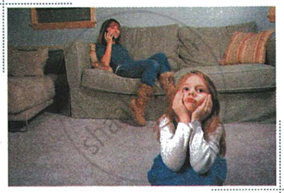 |
Identify the type of parenting by observing the picture.
Neglecting
Authoritative
Both Neglecting and Authoritative
Ignorance of the feelings
Identify the given picture.
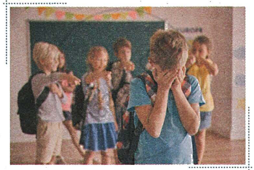 |
Identify the act in the picture.
Bullying
Socialising
Playing
Cooperation
Identify the given picture.
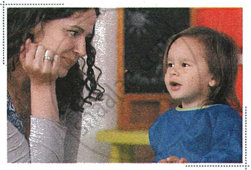 |
Identify the picture.
Socially unskilled
Bullying the child
Punishing the child
Developing communication skill
State True or False:
Incapable of initiating interaction is a sign of rejection by parents.
State True or False:
The schools discourage creating conditions for proper behaviour and habits of children.
State True or False:
The purpose of the peer group is to satisfy the need of belonging to a group.
Select the odd one:
The traits of a kid who gets bullied are
- Shows fear of pain
- Have a negative self-concept
- Cooperative
- Poor physical coordination
Select the odd one:
Authoritarian parents are
- High in demandingness and low in responsiveness
- Strict and autocratic
- Expect obedience
- Believe in discussion
Select the odd one:
The purpose of peer group is
- Breaks rules
- Influence in cognitive and social development
- Influence the development of values and morals
- Teaches acceptable behaviour
Identify the correct statement:
Assertion (A): Peer group have positive and negative influences on children.
Reason (R): Some children are dominant and others are submissive.
A is true but R is false.
A is false but R is true.
Both A and R are true and R is the correct explanation of A.
Both A and R are true and R is not the correct explanation of A.
Assertion (A): Extracurricular activities help to develop a child’s self-esteem.
Reason (R): School is the next home for children and they feel safe in school.
A is true but R is false.
A is false but R is true.
Both A and R are true and R is the correct explanation of A.
Both A and R are true and R is not the correct explanation of A.
Assertion (A): Family is the first socializing agency.
Reason (R): The family teaches a child about human relationship.
A is true but R is false.
A is false but R is true.
Both A and R are true and R is the correct explanation of A.
Both A and R are true and R is not the correct explanation of A.
Choose the correct pair:
Authoritative parent - Supportive
Authoritarian parent - Demanding
Permissive parent - Unsupportive
Rejecting parent - Undemanding
Choose the correct pair:
Disciplinary rules - positive reinforcement
Motivation - unusual behaviour
Punishment - wrong behaviour
Responsibility - independent behaviour
Select the incorrect pair:
Society - disruptive
Peer group - second home
School - safe
Family - develops antisocial behaviour
Select the incorrect pair:
Bully - physically stronger
Bullied - sensitive
Negative influence - adaptive to confirming
Positive influence - Cooperative
Choose the correct pair:
| A. | Authoritative parenting style | 1. | Warm and Responsive |
| B. | Authoritarian parenting style | 2. | Set balanced boundaries |
| C. | Neglecting parenting style | 3. | Adhering to rules |
| D. | Permissive parenting style | 4. | Uninvolved |
A - 1, В - 3, C - 4, D - 2
A - 2, В - 3, С - 4, D - 1
A - 2, В - 4, С - 1, D - 3
A - 3, В - 2, С - 1, D - 4
Choose the correct statement:
Statement I: A responsive parenting approach, where parents promptly and appropriately respond to their child’s needs, fosters a sense of security and helps in the child’s emotional and social development.
Statement II: Parental responsiveness is unimportant in the early years, as children only begin to recognize and respond to their parents’ actions after the age of five.
Statement I is true and Statement II is false.
Statement I is false and Statement II is true.
Both Statements I and II are true.
Both Statements I and II are false.
Statement I: Peer groups play a significant role in helping children develop social skills.
Statement II: The influence of peer groups is insignificant during childhood, as children only begin to form meaningful social connections during adolescence.
Statement I is true and Statement II is false.
Statement I is false and Statement II is true.
Both Statements I and II are true.
Both Statements I and II are false.
Choose the correct pair:
| A. | Consistent discipline | 1. | Understanding boundaries and self-control |
| B. | Encouragement of independence | 2. | Building self-confidence and decision-making |
| C. | Educational support | 3. | Fostering cognitive skills and curiosity |
| D. | Physical care and nutrition | 4. | Ensuring healthy growth and development |
A - 1, B - 2, C - 3, D - 4
A - 3, B - 1, C - 4, D - 2
A - 2, B - 4, C - 1, D - 3
A - 4, B - 3, C - 2, D - 1
Choose the correct pair:
| A. | Providing structured learning | 1. | Development of cognitive skills |
| B. | Encouraging teamwork | 2. | Building social skills and cooperation |
| C. | Offering extracurricular activities | 3. | Enhancing creativity and physical health |
| D. | Establishing rules and routines | 4. | Understanding discipline and responsibility |
A - 1, B - 2, C - 3, D - 4
A - 2, B - 3, C - 1, D - 4
A - 3, B - 1, C - 4, D - 2
A - 4, B - 1, C - 2, D - 3
SHORT QUESTIONS
What factors at home determine the personality of a child?
What is Parental Responsiveness?
Name the four parenting styles.
Which parenting style is the best? Why?
When should children be rewarded?
Why should children be rewarded?
How peer group is characterised by?
How does social interaction increase in children between 6-12 years?
List any four traits of a victim being bullied.
How should adults intervene to help a child being bullied?
Explain positive peer influence on a child.
Explain negative peer influence on a child.
LONG QUESTIONS
What is Parental Demandingness?
What is Parental Responsiveness?
Name the four parenting styles.
Name the four parenting styles.
Discuss the role parents play in child’s life during middle childhood.
Discuss the role of a peer group in the development of a child.
Explain how rejection influence a child.
Explain how acceptance influence a child.
State five ways how parents and teachers can improve communication with children.
Sarah, a struggling third-grader in math, received increased support from her parents, leading to a significant improvement in her understanding and confidence in the subject. Their involvement fostered a positive learning environment, enhancing her academic performance.
In this context, answer the following question:
Explain the role of peer groups in shaping a child’s self-esteem and identity.
Sarah, a struggling third-grader in math, received increased support from her parents, leading to a significant improvement in her understanding and confidence in the subject. Their involvement fostered a positive learning environment, enhancing her academic performance.
In this context, answer the following question:
Describe the role of communication with parents.
Sarah, a struggling third-grader in math, received increased support from her parents, leading to a significant improvement in her understanding and confidence in the subject. Their involvement fostered a positive learning environment, enhancing her academic performance.
In this context, answer the following question:
How can negative influence shape a child’s self-esteem and identity?
From the initial lessons of “raising their hand to speak”, “waiting for their turn”, “keep their hands towards themselves” to later debates on moral and social issues, a child is moulded to have their own set of beliefs about the world and themselves.
In this context, answer the following question:
Describe the role of the teacher in the school.
From the initial lessons of “raising their hand to speak”, “waiting for their turn”, “keep their hands towards themselves” to later debates on moral and social issues, a child is moulded to have their own set of beliefs about the world and themselves.
In this context, answer the following question:
List any two traits of a kid who gets bullied.
From the initial lessons of “raising their hand to speak”, “waiting for their turn”, “keep their hands towards themselves” to later debates on moral and social issues, a child is moulded to have their own set of beliefs about the world and themselves.
In this context, answer the following question:
What are the various skills developed in school?
Discuss the role of parents in handling children with learning disabilities.
Discuss five ways in which social development forms an integral part of a child’s development.
Solutions for 5: Role of Family, Peer Group and School
Dr. Alka Agarwal solutions for होम साइंस [अंग्रेजी] कक्षा १० आईसीएसई chapter 5 - Role of Family, Peer Group and School
Shaalaa.com has the CISCE Mathematics होम साइंस [अंग्रेजी] कक्षा १० आईसीएसई CISCE solutions in a manner that help students grasp basic concepts better and faster. The detailed, step-by-step solutions will help you understand the concepts better and clarify any confusion. Dr. Alka Agarwal solutions for Mathematics होम साइंस [अंग्रेजी] कक्षा १० आईसीएसई CISCE 5 (Role of Family, Peer Group and School) include all questions with answers and detailed explanations. This will clear students' doubts about questions and improve their application skills while preparing for board exams.
Further, we at Shaalaa.com provide such solutions so students can prepare for written exams. Dr. Alka Agarwal textbook solutions can be a core help for self-study and provide excellent self-help guidance for students.
Concepts covered in होम साइंस [अंग्रेजी] कक्षा १० आईसीएसई chapter 5 Role of Family, Peer Group and School are Role of the Family, Role of Peer Group, Role of Schools.
Using Dr. Alka Agarwal होम साइंस [अंग्रेजी] कक्षा १० आईसीएसई solutions Role of Family, Peer Group and School exercise by students is an easy way to prepare for the exams, as they involve solutions arranged chapter-wise and also page-wise. The questions involved in Dr. Alka Agarwal Solutions are essential questions that can be asked in the final exam. Maximum CISCE होम साइंस [अंग्रेजी] कक्षा १० आईसीएसई students prefer Dr. Alka Agarwal Textbook Solutions to score more in exams.
Get the free view of Chapter 5, Role of Family, Peer Group and School होम साइंस [अंग्रेजी] कक्षा १० आईसीएसई additional questions for Mathematics होम साइंस [अंग्रेजी] कक्षा १० आईसीएसई CISCE, and you can use Shaalaa.com to keep it handy for your exam preparation.
