Advertisements
Advertisements
A liquid rises to a height of 5 cm in a glass capillary tube of radius 0.02 cm. The height to which the liquid would rise in a glass capillary tube of radius 0.04 cm is ______.
Concept: undefined >> undefined
What is the excess of pressure inside a soap bubble of radius 3 cm if the surface tension of the soap solution is 30 dyne/cm?
Concept: undefined >> undefined
Advertisements
A steel blade floats on the surface of pure water. When detergent is added, it sinks, why? What is capillarity?
Concept: undefined >> undefined
Absorption of water by filter paper is due to ______.
Concept: undefined >> undefined
A conductor carrying a current I has three segments, as shown in figure. What is the magnetic field B at the centre of curvature C of the semicircle?
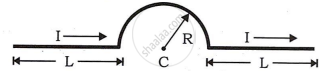
Concept: undefined >> undefined
A capillary tube of radius 1 mm is immersed in a beaker of mercury. The mercury level inside the tube is found to be 0.536 cm below the level in the reservoir. Determine the angle of contact between the mercury and glass. (Given: T = 0.485 N/m, p = 13.6 x 10³ kg/m3)
Concept: undefined >> undefined
Compare streamline flow and Turbulent flow.
Concept: undefined >> undefined
Multiple Choice Question.
Two hailstones with radii in the ratio of 1:4 fall from a great height through the atmosphere. Then the ratio of their terminal velocities is
Concept: undefined >> undefined
Why does velocity increase when water flowing in broader pipe enters a narrow pipe?
Concept: undefined >> undefined
With what terminal velocity will an air bubble 0.4 mm in diameter rise in a liquid of viscosity 0.1 Ns/m2 and specific gravity 0.9? Density of air is 1.29 kg/m3.
Concept: undefined >> undefined
Calculate the viscous force acting on a raindrop of diameter 1 mm, falling with a uniform velocity of 2 m/s through air. The coefficient of viscosity of air is 1.8 × 10⁻⁵ Ns/m2.
Concept: undefined >> undefined
A horizontal force of 1 N is required to move a metal plate of area 10-2 m2 with a velocity of 2 × 10⁻² m/s, when it rests on a layer of oil 1.5 × 10⁻³ m thick. Find the coefficient of viscosity of oil.
Concept: undefined >> undefined
Two stones with radii 1:2 fall from a great height through the atmosphere. Their terminal velocities are in the ratio ______
Concept: undefined >> undefined
What is the net weight of a body when it falls with terminal velocity through a viscous medium?
Concept: undefined >> undefined
A square metal plate of area 100 cm2 moves parallel to another plate with a velocity of 10 cm/s, both plates immersed in water. If the viscous force is 200 dyne and the viscosity of water is 0.01 poise, what is the distance between them?
Concept: undefined >> undefined
The relative velocity between two parallel layers of water is 8 cm/s and the perpendicular distance between them is 0.1 cm. Calculate the velocity gradient.
Concept: undefined >> undefined
A raindrop of radius 0.3 mm falls through the air with a terminal velocity of 1 m/s. The viscosity of air is 18 x 10−6 Ns /m2. Find the viscous force on the raindrop.
Concept: undefined >> undefined
State the formula for critical velocity in terms of Reynold's number for a flow of a fluid.
Concept: undefined >> undefined
What are the two main causes of turbulent flow?
Concept: undefined >> undefined
Define the coefficient of viscosity.
Concept: undefined >> undefined
