Advertisements
Advertisements
Convert the following pressure value into Pascals.
10 atmosphere
Concept: undefined >> undefined
Convert the following pressure value into Pascals.
1 kPa
Concept: undefined >> undefined
Advertisements
Convert the following pressure value into Pascals.
107000 Nm−2
Concept: undefined >> undefined
Convert the following pressure value into Pascals.
1 atmosphere
Concept: undefined >> undefined
Convert exactly 1.5 atm to pascals
Concept: undefined >> undefined
Convert 89 kPa to newton per square metre (Nm−2)
Concept: undefined >> undefined
Convert 101.325 kPa to bar.
Concept: undefined >> undefined
Convert −100° C to kelvin
Concept: undefined >> undefined
Convert 0.124 torr to the standard atmosphere
Concept: undefined >> undefined
Write the balanced chemical reaction to get benzene from Sodium benzoate.
Concept: undefined >> undefined
Write the balanced chemical reaction to get benzene from Phenol.
Concept: undefined >> undefined
Predict the possible product of the following reaction.
Chlorination of nitrobenzene
Concept: undefined >> undefined
Predict the possible product of the following reaction.
sulphonation of chlorobenzene
Concept: undefined >> undefined
Predict the possible product of the following reaction.
bromination of phenol
Concept: undefined >> undefined
Predict the possible product of the following reaction.
nitration of toluene
Concept: undefined >> undefined
Identify the main product of the reaction.
\[\begin{array}{cc}
\ce{CH3 - CH - CH3 ->[{60%}H2SO4][373 K]}\\
|\phantom{............}\\\ce{OH}\phantom{..........}
\end{array}\] _______.
Concept: undefined >> undefined
Identify the main product of the reaction:
\[\ce{HC ≡ C - CH3 ->[H2][Pd-C/quinoline]}\] _______.
Concept: undefined >> undefined
Identify the main product of the reaction:
\[\ce{H - C ≡ C - H + H - O ->[{40%} H2SO4][{1%} HgSO4]}\] _____.
Concept: undefined >> undefined
Identify A, B, C in the following reaction sequence:
\[\ce{CH3 - CH = CH2 ->[Br2/CCl4][room temperature] A ->[Zn] B ->[dil. alkaline][KMnO4] C}\]
Concept: undefined >> undefined
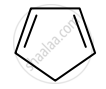
Identify giving reason whether the following compound is aromatic or not.
Concept: undefined >> undefined
