Advertisements
Advertisements
Explain the Indian ocean with respect to the following aspects :
Abyssal Plains
Concept: undefined >> undefined
Give a geographical reason:
Gyre develops in the Southern Indian Ocean.
Concept: undefined >> undefined
Advertisements
1) Various biome regions have been shown on the map. Considering the latitudinal location, select the Tundra biome and write the name in its respective place in the index.
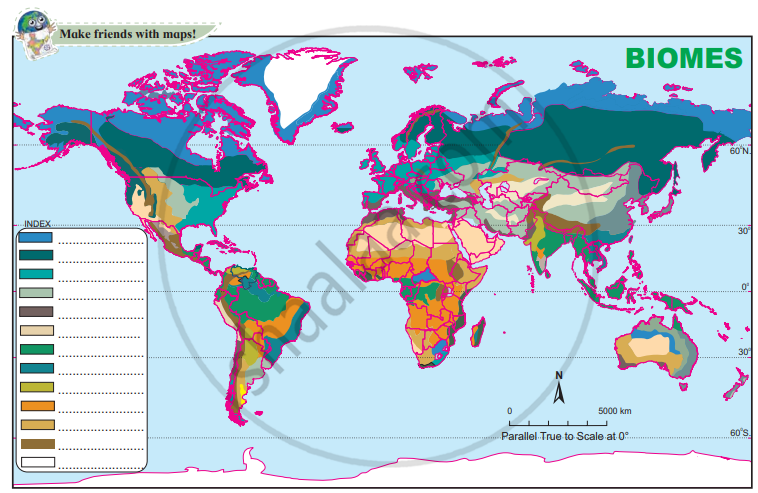
2) Write the names of the major countries that lie in the Tundra biome.
Concept: undefined >> undefined
- What would be the annual range of temperature in Taiga or Sub-Arctic? What could be the occupational activities carried out by humans here?
- What type of weathering will be prominent in the Taiga or Sub-Arctic region?
Concept: undefined >> undefined
Read graphs a and b and answer the following questions. Locate the places on the map:


- Note the values of the axes. How different are these graphs from the earlier ones?
- Note the highest and the lowest temperatures and their months
- Note the highest and the lowest rainfall and their months.
- Why does not a place from Southern Hemisphere appear here?
- What factors are responsible for this climate?
Concept: undefined >> undefined
Choose the correct alternative:
Lumbering flourished as an occupation from Newfoundland to Alaska in North America because:
Concept: undefined >> undefined
Give a geographical reason:
Taiga region is not found in Southern Hemisphere.
Concept: undefined >> undefined
Differentiate between:
Taiga and Tundra regions
Concept: undefined >> undefined
1) Various biome regions have been shown on the map. Considering the latitudinal location, select Mountain or highland biome and write the name in its respective place in the index.

2) Write the names of the major regions that lie in the Mountain or highland biome.
Concept: undefined >> undefined
Distinguish between:
Human activities in tropical evergreen and Monsoon regions.
Concept: undefined >> undefined
Read the graphs figuare a and b and answer the following questions. Locate the places on the map


- Note the values of the axes. How different are these graphs from the earlier ones?
- Note the highest and the lowest temperatures and their months
- Note the highest and the lowest rainfall and their months.
- Why does not a place from Southern Hemisphere appear here?
- What factors are responsible for this climate?
Concept: undefined >> undefined
What kinds of mass movement may happen in the Tundra region?
Concept: undefined >> undefined
Read the graphs figure a and b and answer the following questions. Locate the places on the map:
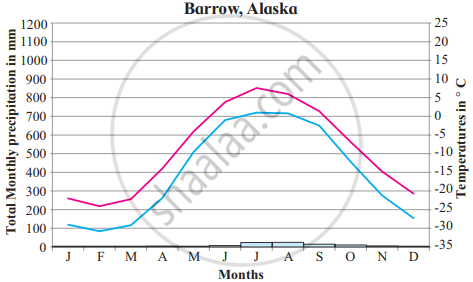
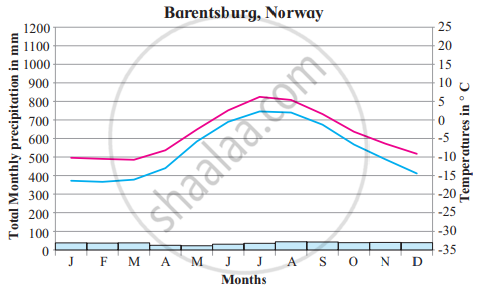
- Why is it that both the graphs are from the Northern Hemisphere?
- Which are the warmest and the coolest months?
- What is the annual range of temperature?
- Why does not the duration of the day (sometimes more than 24 hours) influence its temperatures or precipitation?
Concept: undefined >> undefined
Read the graphs figure a and b and answer the following questions. Locate the places on the map:
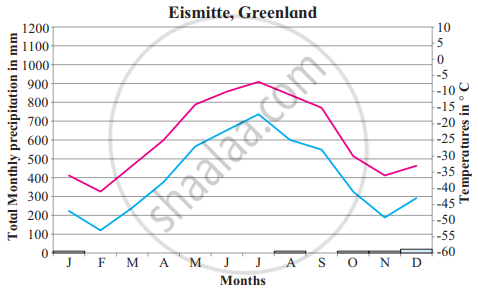
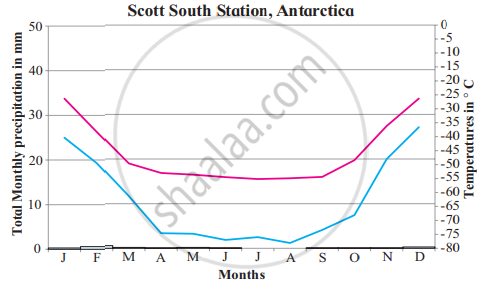
- Which are the warmest and the coolest months?
- Name the months of highest and lowest rainfall.
- In what way do you find similarities in this climate with other climate types of high latitudes?
- What factors influence this type of climate?
Concept: undefined >> undefined
- What type of human activities will develop in the High-altitude regions?
- In what ways might high latitudes be different from high altitudes?
Concept: undefined >> undefined
Read the graphs figure a and b and answer the following questions. Locate the places on the map:


- Which are the warmest and the coolest months?
- Name the months of highest and lowest precipitation.
- In what way do you find similarities in this climate with other climate types of high latitudes?
- Why are the axes showing temperatures different in both the graphs?
- What factors influence this type of climate?
Concept: undefined >> undefined
