Advertisements
Advertisements
Find the distance between the following pairs of point.
W `((- 7)/2 , 4)`, X (11, 4)
Concept: undefined >> undefined
Determine whether the points are collinear.
A(1, −3), B(2, −5), C(−4, 7)
Concept: undefined >> undefined
Advertisements
Determine whether the points are collinear.
L(–2, 3), M(1, –3), N(5, 4)
Concept: undefined >> undefined
Four alternative answers for the following question are given. Choose the correct alternative and write its alphabet:
Out of the dates given below which date constitutes a Pythagorean triplet?
Concept: undefined >> undefined
Determine whether the point is collinear.
R(0, 3), D(2, 1), S(3, –1)
Concept: undefined >> undefined
Determine whether the points are collinear.
P(–2, 3), Q(1, 2), R(4, 1)
Concept: undefined >> undefined
Find x if distance between points L(x, 7) and M(1, 15) is 10.
Concept: undefined >> undefined
Show that the points A(1, 2), B(1, 6), C(1 + 2`sqrt3`, 4) are vertices of an equilateral triangle.
Concept: undefined >> undefined
In ∆ABC, B - D - C and BD = 7, BC = 20 then find following ratio.
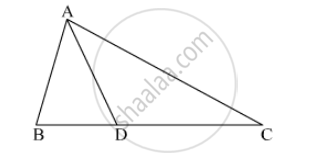
`"A(∆ ABD)"/"A(∆ ADC)"`
Concept: undefined >> undefined
Ratio of areas of two triangles with equal heights is 2 : 3. If base of the smaller triangle is 6 cm then what is the corresponding base of the bigger triangle ?
Concept: undefined >> undefined
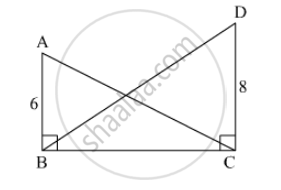
In the given figure, ∠ABC = ∠DCB = 90° AB = 6, DC = 8 then `(A(Δ ABC))/(A(Δ DCB))` = ?
Concept: undefined >> undefined
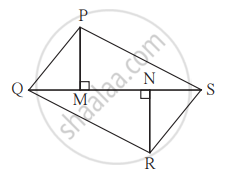
In the figure, PM = 10 cm, A(∆PQS) = 100 sq.cm, A(∆QRS) = 110 sq. cm, then find NR.
Concept: undefined >> undefined
Find the distances between the following point.
A(a, 0), B(0, a)
Concept: undefined >> undefined
Find the distances between the following point.
P(–6, –3), Q(–1, 9)
Concept: undefined >> undefined
Find the distances between the following point.
R(–3a, a), S(a, –2a)
Concept: undefined >> undefined
Show that the ▢PQRS formed by P(2, 1), Q(–1, 3), R(–5, –3) and S(–2, –5) is a rectangle.
Concept: undefined >> undefined
AB and AC are the two chords of a circle whose radius is r. If p and q are
the distance of chord AB and CD, from the centre respectively and if
AB = 2AC then proove that 4q2 = p2 + 3r2.
Concept: undefined >> undefined
Distance of point (−3, 4) from the origin is ______.
Concept: undefined >> undefined
From the given number line, find d(A, B):

Concept: undefined >> undefined
Show that the points (2, 0), (–2, 0), and (0, 2) are the vertices of a triangle. Also, a state with the reason for the type of triangle.
Concept: undefined >> undefined
