Advertisements
Advertisements
In triangle ABC; AB = AC and ∠A : ∠B = 8 : 5; find angle A.
Concept: undefined >> undefined
Using the information given of the following figure, find the values of a and b.
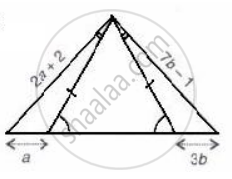
Concept: undefined >> undefined
Advertisements
If the equal sides of an isosceles triangle are produced, prove that the exterior angles so formed are obtuse and equal.
Concept: undefined >> undefined
In isosceles triangle ABC, AB = AC. The side BA is produced to D such that BA = AD.
Prove that: ∠BCD = 90°
Concept: undefined >> undefined
ABC is a triangle. The bisector of the angle BCA meets AB in X. A point Y lies on CX such that AX = AY.
Prove that: ∠CAY = ∠ABC.
Concept: undefined >> undefined
Use the given figure to prove that, AB = AC.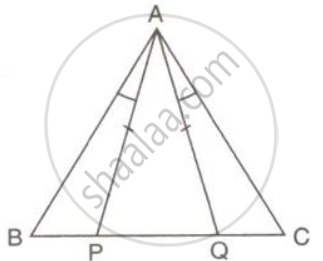
Concept: undefined >> undefined
Prove that the medians corresponding to equal sides of an isosceles triangle are equal.
Concept: undefined >> undefined
The bisectors of the equal angles B and C of an isosceles triangle ABC meet at O. Prove that AO bisects angle A.
Concept: undefined >> undefined
Using ruler and compasses only, construct a trapezium ABCD, in which the parallel sides AB and DC are 3.3 cm apart; AB = 4.5 cm, angle A = 120o BC = 3.6 cm and angle B is obtuse.
Concept: undefined >> undefined
Construct a trapezium ABCD, when:
AB = 4.8 cm, BC = 6.8 cm, CD = 5.4 cm, angle B = 60o and AD // BC.
Concept: undefined >> undefined
Construct a trapezium ABCD, when:
AB = CD = 3.2 cm, BC = 6.0 cm, AD = 4.4 cm and AD // BC.
Concept: undefined >> undefined
The following figure shows a triangle ABC in which P, Q, and R are mid-points of sides AB, BC and CA respectively. S is mid-point of PQ:
Prove that: ar. ( ∆ ABC ) = 8 × ar. ( ∆ QSB )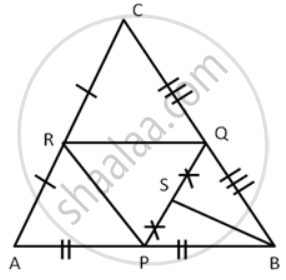
Concept: undefined >> undefined
In the given figure; AD is median of ΔABC and E is any point on median AD.
Prove that Area (ΔABE) = Area (ΔACE).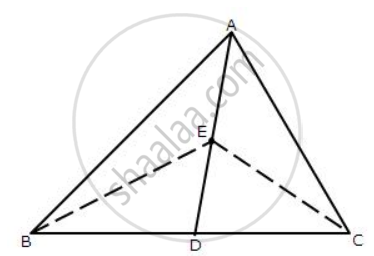
Concept: undefined >> undefined
In the figure of question 2, if E is the mid-point of median AD, then
prove that:
Area (ΔABE) = `1/4` Area (ΔABC).
Concept: undefined >> undefined
The base BC of triangle ABC is divided at D so that BD = `1/2`DC.
Prove that area of ΔABD = `1/3` of the area of ΔABC.
Concept: undefined >> undefined
In the following figure, OAB is a triangle and AB || DC.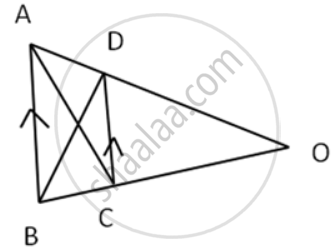
If the area of ∆ CAD = 140 cm2 and the area of ∆ ODC = 172 cm2,
find : (i) the area of ∆ DBC
(ii) the area of ∆ OAC
(iii) the area of ∆ ODB.
Concept: undefined >> undefined
Use the table given below to find:
(a) The actual class limits of the fourth class.
(b) The class boundaries of the sixth class.
(c) The class mark of the third class.
(d) The upper and lower limits of the fifth class.
(e) The size of the third class.
| Class Interval | Frequency |
| 30 - 34 | 7 |
| 35 - 39 | 10 |
| 40 - 44 | 12 |
| 45 - 49 | 13 |
| 50 - 54 | 8 |
| 55 - 59 | 4 |
Concept: undefined >> undefined
The base of an isosceles triangle is 24 cm and its area is 192 sq. cm. Find its perimeter.
Concept: undefined >> undefined
Four identical cubes are joined end to end to form a cuboid. If the total surface area of the resulting cuboid as 648 m2; find the length of the edge of each cube. Also, find the ratio between the surface area of the resulting cuboid and the surface area of a cube.
Concept: undefined >> undefined
The volume of a cube is 729 cm3. Find its total surface area.
Concept: undefined >> undefined
