Advertisements
Advertisements
Fill the blank spaces in the table given below:
| Nature of bar | Action of compass needle | |
| North Pole | South Pole | |
| Non-magnetic | No action | ________ |
| ________ | attracted | attracted |
| North pole of a bar magnet | ________ | _________ |
| ________ | attracted | repelled |
Concept: undefined >> undefined
There are two knitting needles. One of them is magnetized. How will you find out which one is magnetized, if no other magnet is available?
Concept: undefined >> undefined
Advertisements
Describe two simple experiments to support the statement that magnetism is a property of the molecules of a magnet.
Concept: undefined >> undefined
What do you understand by the term independent variable?
Concept: undefined >> undefined
Describe, how you will proceed to determine the position of the pole of a bar magnet.
Concept: undefined >> undefined
What do you understand by the term dependent variable?
Concept: undefined >> undefined
Draw lines of force surrounding a bar magnet when it is placed in the magnetic meridian with its north pole pointing geographic, north.
Concept: undefined >> undefined
Draw lines of force surrounding a bar magnet when it is placed in the magnetic meridian with its north pole pointing geographic south.
Concept: undefined >> undefined
Bar magnets are often stored in pairs as shown in the figure. E and F being pieces of metal.
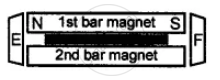
Name the metal used for E and F.
Concept: undefined >> undefined
Bar magnets are often stored in pairs as shown in the figure. E and F being pieces of metal.
Why are E and F placed in contact with the poles of the magnets as shown in the diagram?
Concept: undefined >> undefined
Bar magnets are often stored in pairs as shown in the figure. E and F being pieces of metal.
Mark on the diagram the poles of the second magnet,
Concept: undefined >> undefined
Bar magnets are often stored in pairs as shown in the figure. E and F being pieces of metal.
What is the material of darkened part?
Concept: undefined >> undefined
The figure shows a freely suspended magnet in the rest position. Copy the diagram and on its show:
- Angle of declination
- Angle in dip

Concept: undefined >> undefined
Since every iron atom is a tiny magnet, why are not all iron bar magnets?
Concept: undefined >> undefined
If a magnet is carefully broken into two pieces as shown in figure (i), how does the magnetic strength of each piece compare with that of the original magnet? If another magnet is carefully broken in half along its long axis shown in figure (ii), how would the strength of each piece compare with that of the original magnet?
Concept: undefined >> undefined
Draw the magnetic flux pattern near a bar magnet placed with its axis in the magnetic meridian and the south pole pointing towards geographic north.
Concept: undefined >> undefined
Draw a clearly labelled diagram, to show how a steel bar is magnetised by a divided touch method. A written description is not required.
Concept: undefined >> undefined
What do you understand by the term rest? Support your answer by giving two examples
Concept: undefined >> undefined
What do you understand by the term motion? Support your answer by giving two examples
Concept: undefined >> undefined
What are magnetic keepers? What are they used for?
Concept: undefined >> undefined
