हिंदी

Science (English Medium) कक्षा १२ - CBSE Question Bank Solutions for Chemistry

Advertisements
[object Object]
[object Object]
विषयों
मुख्य विषय
अध्याय
Advertisements
Advertisements
Chemistry
< prev  2681 to 2700 of 4805  next > 

Read the passage given below and answer the following question:

Nucleophilic substitution reaction of haloalkane can be conducted according to both SN1 and SN2 mechanisms. However, which mechanism it is based on is related to such factors as the structure of haloalkane, and properties of leaving group, nucleophilic reagent and solvent.

Influences of halogen: No matter which mechanism the nucleophilic substitution reaction is based on, the leaving group always leave the central carbon atom with electron pair. This is just the opposite of the situation that nucleophilic reagent attacks the central carbon atom with electron pair. Therefore, the weaker the alkalinity of leaving group is, the more stable the anion formed is and it will be more easier for the leaving group to leave the central carbon atom; that is to say, the reactant is more easier to be substituted. The alkalinity order of halogen ion is I < Br < Cl < F and the order of their leaving tendency should be I > Br > Cl > F. Therefore, in four halides with the same alkyl and different halogens, the order of substitution reaction rate is RI > RBr > RCl > RF. In addition, if the leaving group is very easy to leave, many carbocation intermediates are generated in the reaction and the reaction is based on SN1 mechanism. If the leaving group is not easy to leave, the reaction is based on SN2 a mechanism.

Influences of solvent polarity: In SN1 reaction, the polarity of the system increases from the reactant to the transition state, because polar solvent has a greater stabilizing effect on the transition state than the reactant, thereby reduce activation energy and accelerate the reaction. In SN2 reaction, the polarity of the system generally does not change from the reactant to the transition state and only charge dispersion occurs. At this time, polar solvent has a great stabilizing effect on Nu than the transition state, thereby increasing activation energy and slow down the reaction rate. For example, the decomposition rate (SN1) of tertiary chlorobutane in 25℃ water (dielectric constant 79) is 300000 times faster than in ethanol (dielectric constant 24). The reaction rate (SN2) of 2-bromopropane and NaOH in ethanol containing 40% water is twice slower than in absolute ethanol. In a word, the level of solvent polarity has influence on both SN1 and SN2 reactions, but with different results. Generally speaking, weak polar solvent is favorable for SN2 reaction, while strong polar solvent is favorable for SN1 reaction, because only under the action of polar solvent can halogenated hydrocarbon dissociate into carbocation and halogen ion and solvents with a strong polarity is favorable for solvation of carbocation, increasing its stability. Generally speaking, the substitution reaction of tertiary haloalkane is based on SN1 mechanism in solvents with a strong polarity (for example, ethanol containing water).

Nucleophilic substitution will be fastest in case of ______.

[6] Haloalkanes and Haloarenes
Chapter: [6] Haloalkanes and Haloarenes
Concept: undefined >> undefined

Read the passage given below and answer the following question:

Nucleophilic substitution reaction of haloalkane can be conducted according to both SN1 and SN2 mechanisms. However, which mechanism it is based on is related to such factors as the structure of haloalkane, and properties of leaving group, nucleophilic reagent and solvent.

Influences of halogen: No matter which mechanism the nucleophilic substitution reaction is based on, the leaving group always leave the central carbon atom with electron pair. This is just the opposite of the situation that nucleophilic reagent attacks the central carbon atom with electron pair. Therefore, the weaker the alkalinity of leaving group is, the more stable the anion formed is and it will be more easier for the leaving group to leave the central carbon atom; that is to say, the reactant is more easier to be substituted. The alkalinity order of halogen ion is I < Br < Cl < F and the order of their leaving tendency should be I > Br > Cl > F. Therefore, in four halides with the same alkyl and different halogens, the order of substitution reaction rate is RI > RBr > RCl > RF. In addition, if the leaving group is very easy to leave, many carbocation intermediates are generated in the reaction and the reaction is based on SN1 mechanism. If the leaving group is not easy to leave, the reaction is based on SN2 a mechanism.

Influences of solvent polarity: In SN1 reaction, the polarity of the system increases from the reactant to the transition state, because polar solvent has a greater stabilizing effect on the transition state than the reactant, thereby reduce activation energy and accelerate the reaction. In SN2 reaction, the polarity of the system generally does not change from the reactant to the transition state and only charge dispersion occurs. At this time, polar solvent has a great stabilizing effect on Nu than the transition state, thereby increasing activation energy and slow down the reaction rate. For example, the decomposition rate (SN1) of tertiary chlorobutane in 25℃ water (dielectric constant 79) is 300000 times faster than in ethanol (dielectric constant 24). The reaction rate (SN2) of 2-bromopropane and NaOH in ethanol containing 40% water is twice slower than in absolute ethanol. In a word, the level of solvent polarity has influence on both SN1 and SN2 reactions, but with different results. Generally speaking, weak polar solvent is favorable for SN2 reaction, while strong polar solvent is favorable for SN1 reaction, because only under the action of polar solvent can halogenated hydrocarbon dissociate into carbocation and halogen ion and solvents with a strong polarity is favorable for solvation of carbocation, increasing its stability. Generally speaking, the substitution reaction of tertiary haloalkane is based on SN1 mechanism in solvents with a strong polarity (for example, ethanol containing water).

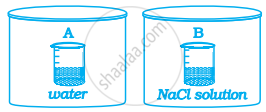
SN1 reaction will be fastest in which of the following solvents?

[6] Haloalkanes and Haloarenes
Chapter: [6] Haloalkanes and Haloarenes
Concept: undefined >> undefined

Advertisements

Which of the following is not true about the voids formed in 3 dimensional hexagonal close packed structure?

(i) A tetrahedral void is formed when a sphere of the second layer is present above triangular void in the first layer.

(ii) All the triangular voids are not covered by the spheres of the second layer.

(iii) Tetrahedral voids are formed when the triangular voids in the second layer lie above the triangular voids in the first layer and the triangular shapes of these voids do not overlap.

(iv) Octahedral voids are formed when the triangular voids in the second layer exactly overlap with similar voids in the first layer.

[1] Solid State
Chapter: [1] Solid State
Concept: undefined >> undefined

The number of tetrahedral voids per unit cell in NaCl crystal is:

(i) 4

(ii) 8

(iii) twice the number of octahedral voids.

(iv) four times the number of octahedral voids.

[1] Solid State
Chapter: [1] Solid State
Concept: undefined >> undefined

In a compound, nitrogen atoms (N) make cubic close packed lattice and metal atoms (M) occupy one-third of the tetrahedral voids present. Determine the formula of the compound formed by M and N?

[1] Solid State
Chapter: [1] Solid State
Concept: undefined >> undefined

Show that in a cubic close packed structure, eight tetrahedral voids are present per unit cell.

[1] Solid State
Chapter: [1] Solid State
Concept: undefined >> undefined

On the basis of information given below mark the correct option.

(A) In bromoethane and chloroethane mixture intermolecular interactions of A–A and B–B type are nearly same as A–B type interactions.

(B) In ethanol and acetone mixture A–A or B–B type intermolecular interactions are stronger than A–B type interactions.

(C) In chloroform and acetone mixture A–A or B–B type intermolecular interactions are weaker than A–B type interactions.

[1] Solutions
Chapter: [1] Solutions
Concept: undefined >> undefined

On the basis of information given below mark the correct option.
On adding acetone to methanol some of the hydrogen bonds between methanol molecules break.

[1] Solutions
Chapter: [1] Solutions
Concept: undefined >> undefined

Using Raoult’s law explain how the total vapour pressure over the solution is related to mole fraction of components in the following solutions.

\[\ce{CHCl3(l) and CH2Cl2(l)}\]

[1] Solutions
Chapter: [1] Solutions
Concept: undefined >> undefined

Using Raoult’s law explain how the total vapour pressure over the solution is related to mole fraction of components in the following solutions.

\[\ce{NaCl(s) and H2O(l)}\]

[1] Solutions
Chapter: [1] Solutions
Concept: undefined >> undefined

Why is alternating current used for measuring resistance of an electrolytic solution?

[2] Electrochemistry
Chapter: [2] Electrochemistry
Concept: undefined >> undefined

Which of the following statements is incorrect about the collison theory of chemical reaction?

[3] Chemical Kinetics
Chapter: [3] Chemical Kinetics
Concept: undefined >> undefined

Which of the following statements are applicable to a balanced chemical equation of an elementary reaction?

(i) Order is same as molecularity.

(ii) Order is less than the molecularity.

(iii) Order is greater than the molecularity.

(iv) Molecularity can never be zero.

[3] Chemical Kinetics
Chapter: [3] Chemical Kinetics
Concept: undefined >> undefined

For a reaction A + B `->` Products, the rate law is — Rate = k [A][B]3/2 Can the reaction be an elementary reaction? Explain.

[3] Chemical Kinetics
Chapter: [3] Chemical Kinetics
Concept: undefined >> undefined

Assertion: All collision of reactant molecules lead to product formation.

Reason: Only those collisions in which molecules have correct orientation and sufficient kinetic energy lead to compound formation.

[3] Chemical Kinetics
Chapter: [3] Chemical Kinetics
Concept: undefined >> undefined

All energetically effective collisions do not result in a chemical change. Explain with the help of an example.

[3] Chemical Kinetics
Chapter: [3] Chemical Kinetics
Concept: undefined >> undefined

Identify the optically active compounds from the following:

(i) \[\ce{[Co(en)3]^{3+}}\]

(ii) \[\ce{[trans - [Co(en)2Cl2]^+}\]

(iii) \[\ce{cis - [Co(en)2Cl2]^+}\]

(iv) \[\ce{[Cr(NH3)5Cl]}\]

[5] Coordination Compounds
Chapter: [5] Coordination Compounds
Concept: undefined >> undefined

Which reagent will you use for the following reaction?

\[\ce{CH3CH2CH2CH3 -> CH3CH2CH2CH2Cl + CH3CH2CHClCH3}\]

[6] Haloalkanes and Haloarenes
Chapter: [6] Haloalkanes and Haloarenes
Concept: undefined >> undefined

A primary alkyl halide would prefer to undergo ______.

[6] Haloalkanes and Haloarenes
Chapter: [6] Haloalkanes and Haloarenes
Concept: undefined >> undefined

Which of the statements are correct about above reaction?

(i) (a) and (e) both are nucleophiles.

(ii) In (c) carbon atom is sp3 hybridised.

(iii) In (c) carbon atom is sp2 hybridised.

(iv) (a) and (e) both are electrophiles.

[6] Haloalkanes and Haloarenes
Chapter: [6] Haloalkanes and Haloarenes
Concept: undefined >> undefined
< prev  2681 to 2700 of 4805  next > 
Advertisements
Advertisements
CBSE Science (English Medium) कक्षा १२ Question Bank Solutions
Question Bank Solutions for CBSE Science (English Medium) कक्षा १२ Biology
Question Bank Solutions for CBSE Science (English Medium) कक्षा १२ Chemistry
Question Bank Solutions for CBSE Science (English Medium) कक्षा १२ Computer Science (C++)
Question Bank Solutions for CBSE Science (English Medium) कक्षा १२ Computer Science (Python)
Question Bank Solutions for CBSE Science (English Medium) कक्षा १२ English Core
Question Bank Solutions for CBSE Science (English Medium) कक्षा १२ English Elective - NCERT
Question Bank Solutions for CBSE Science (English Medium) कक्षा १२ Entrepreneurship
Question Bank Solutions for CBSE Science (English Medium) कक्षा १२ Geography
Question Bank Solutions for CBSE Science (English Medium) कक्षा १२ Hindi (Core)
Question Bank Solutions for CBSE Science (English Medium) कक्षा १२ Hindi (Elective)
Question Bank Solutions for CBSE Science (English Medium) कक्षा १२ History
Question Bank Solutions for CBSE Science (English Medium) कक्षा १२ Informatics Practices
Question Bank Solutions for CBSE Science (English Medium) कक्षा १२ Mathematics
Question Bank Solutions for CBSE Science (English Medium) कक्षा १२ Physical Education
Question Bank Solutions for CBSE Science (English Medium) कक्षा १२ Physics
Question Bank Solutions for CBSE Science (English Medium) कक्षा १२ Political Science
Question Bank Solutions for CBSE Science (English Medium) कक्षा १२ Psychology
Question Bank Solutions for CBSE Science (English Medium) कक्षा १२ Sanskrit (Core)
Question Bank Solutions for CBSE Science (English Medium) कक्षा १२ Sanskrit (Elective)
Question Bank Solutions for CBSE Science (English Medium) कक्षा १२ Sociology
Share
Notifications

Englishहिंदीमराठी


      Forgot password?
Use app×