Advertisements
Advertisements
Compare the rms speed of hydrogen molecules at 227°C with the rms speed of oxygen molecules at 127°C. Given that molecular masses of hydrogen and oxygen are 2 and 32 respectively.
Concept: Root Mean Square (RMS) Speed
Prove the Mayer's relation `C_p - C _v = R/J`
Concept: Specific Heat Capacity
A particle performing linear S.H.M. has a period of 6.28 seconds and a pathlength of 20 cm. What is the velocity when its displacement is 6 cm from mean position?
Concept: Differential Equation of Linear S.H.M.
Define linear S.H.M.
Concept: Differential Equation of Linear S.H.M.
If the metal bob of a simple pendulum is replaced by a wooden bob of the same size, then its time period will.....................
- increase
- remain same
- decrease
- first increase and then decrease.
Concept: Some Systems Executing Simple Harmonic Motion
A particle in S.H.M. has a period of 2 seconds and amplitude of 10 cm. Calculate the acceleration when it is at 4 cm from its positive extreme position.
Concept: Simple Harmonic Motion (S.H.M.)
Calculate the average molecular kinetic energy :
(a) per kilomole, (b) per kilogram, of oxygen at 27°C.
(R = 8320 J/k mole K, Avogadro's number = 6*03 x 1026 molecules/K mole)
Concept: K.E.(Kinetic Energy) and P.E.(Potential Energy) in S.H.M.
Obtain an expression for potential energy of a particle performing simple harmonic motion. Hence evaluate the potential energy
- at mean position and
- at extreme position.
Concept: K.E.(Kinetic Energy) and P.E.(Potential Energy) in S.H.M.
A seconds pendulum is suspended in an elevator moving with constant speed in downward direction. The periodic time (T) of that pendulum is _______.
Concept: Periodic and Oscillatory Motion
The pressure (P) of an ideal gas having volume (V) is 2E/3V , then the energy E is _______.
Concept: Phase of K.E (Kinetic Energy)
The periodic time of a linear harmonic oscillator is 2π second, with maximum displacement of 1 cm. If the particle starts from extreme position, find the displacement of the particle after π/3 seconds.
Concept: Periodic and Oscillatory Motion
The maximum velocity of a particle performing linear S.H.M. is 0.16 m/s. If its maximum acceleration is 0.64 m/s2, calculate its period.
Concept: Differential Equation of Linear S.H.M.
The average displacement over a period of S.H.M. is ______.
(A = amplitude of S.H.M.)
Concept: Simple Harmonic Motion (S.H.M.)
Define phase of S.H.M.
Concept: Simple Harmonic Motion (S.H.M.)
The number of degrees of freedom for a rigid diatomic molecule is.................
(a) 3
(b) 5
(c) 6
(d) 7
Concept: Projection of U.C.M.(Uniform Circular Motion) on Any Diameter
Two particles perform linear simple harmonic motion along the same path of length 2A and period T as shown in the graph below. The phase difference between them is ___________.
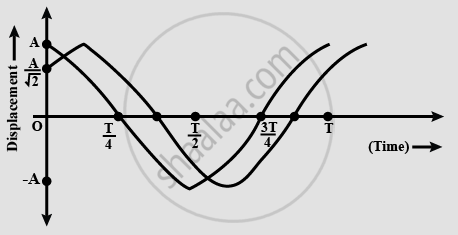
Concept: Differential Equation of Linear S.H.M.
Calculate the kinetic energy of 10 gram of Argon molecules at 127°C.
[Universal gas constant R = 8320 J/k mole K. Atomic weight of Argon = 40]
Concept: Phase of K.E (Kinetic Energy)
A copper metal cube has each side of length 1 m. The bottom edge of the cube is fixed and tangential force 4.2x10⁸ N is applied to a top surface. Calculate the lateral displacement of the top surface if modulus of rigidity of copper is 14x1010 N/m2.
Concept: Periodic and Oscillatory Motion
State an expression for K. E. (kinetic energy) and P. E. (potential energy) at displacement ‘x’ for a particle performing linear S.H. M. Represent them graphically. Find the displacement at which K. E. is equal to P. E.
Concept: K.E.(Kinetic Energy) and P.E.(Potential Energy) in S.H.M.
When the length of a simple pendulum is decreased by 20 cm, the period changes by 10%. Find the original length of the pendulum.
Concept: Some Systems Executing Simple Harmonic Motion
