हिंदी

Commerce (English Medium) कक्षा १२ - CBSE Important Questions for Economics

Advertisements
[object Object]
[object Object]
विषयों
मुख्य विषय
अध्याय
Advertisements
Advertisements
Economics
< prev  321 to 340 of 348  next > 

‘Casual wage work is the major source of employment in rural India’. Defend or refute the given statement with a valid reason.

Appears in 1 question paper
Chapter: [6] Employment: Growth, Informalisation and Other Issues
Concept: Self-employed and Hired Workers

Compare and analyse the sector-wise trends in employment, based on following information:

Trends in Employment (Sector-wise)

Sector 1999-2000 2011-12
Primary sector 60.4 48.9
Secondary sector 15.8 24.3
Tertiary sector 23.8 26.8
Total 100 100
Appears in 1 question paper
Chapter: [6] Employment: Growth, Informalisation and Other Issues
Concept: Growth and Changing Structure of Employment

'Ram is able to get work only for two hours in a day. Rest of the day, he is looking for work.' Is he unemployed? What kind of job could person like Ram be doing?

Appears in 1 question paper
Chapter: [6] Employment: Growth, Informalisation and Other Issues
Concept: Concept of Unemployment

As per the Reserve Bank of India (RBI) press report, dated 29th December, 2022:

"Net external commercial borrowings to India recorded an outflow of US$ 0.4 billion in the second quarter (2022-23)"

The above transaction will be recorded in the _______ account on ______ side of Balance of payments account of India. 

Appears in 1 question paper
Chapter: [6] Open Economy Macroeconomics
Concept: Concept of Balance of Payments >> Capital Account

Read the following chart carefully and choose the correct alternative:
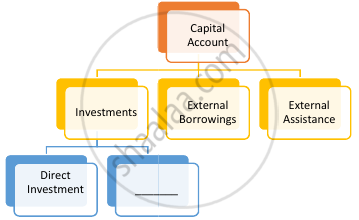
Appears in 1 question paper
Chapter: [6] Open Economy Macroeconomics
Concept: Concept of Balance of Payments >> Capital Account

‘Current account deficit in an economy must be financed by a corresponding capital account surplus’.

Do you agree with the given statement? Give valid reason(s) in support of your answer.

Appears in 1 question paper
Chapter: [6] Open Economy Macroeconomics
Concept: Concept of Balance of Payments >> Balance of Payments Surplus and Deficit

Read the following statements carefully:

Statement 1: The nature of unemployment problem in India is uni-faceted.

Statement 2: Worker-Population ratio is an indicator used for analysing the employment situation in a country.

In light of the given statements, choose the correct alternative from the following:

Appears in 1 question paper
Chapter: [6] Employment: Growth, Informalisation and Other Issues
Concept: Participation of People in Employment

Identify the correct reason(s) that may affect the demand for foreign exchange in an economy.

  1. Imports of visibles
  2. Exports of invisibles
  3. Remittances by residents working abroad
  4. Purchase of assets abroad
Appears in 1 question paper
Chapter: [6] Open Economy Macroeconomics
Concept: Foreign Exchange Rate

“Since independence, the government has been playing an important role in generating employment directly or indirectly.” Discuss.

Appears in 1 question paper
Chapter: [6] Employment: Growth, Informalisation and Other Issues
Concept: Government and Employment Generation

State with valid reason whether the following statement is true or false:

‘Self employed workers are different from hired workers.’

Appears in 1 question paper
Chapter: [6] Employment: Growth, Informalisation and Other Issues
Concept: Self-employed and Hired Workers

‘Pesticides are chemical compounds designed to kill pests. Many pesticides can also pose health risks to people even if exposed to nominal quantities.’

In the light of the above statement, suggest any two traditional methods for replacement of the chemical pesticides.

Appears in 1 question paper
Chapter: [7] Environment and Sustainable Development
Concept: Strategies for Sustainable Development

______ is not a cause for environmental degradation.

Appears in 1 question paper
Chapter: [7] Environment and Sustainable Development
Concept: State of India’s Environment

______ is not the strategy for Sustainable Development.

Appears in 1 question paper
Chapter: [7] Environment and Sustainable Development
Concept: Strategies for Sustainable Development

Explain how Bio-composting can be helpful in achieving the objectives of sustainable development.

Appears in 1 question paper
Chapter: [7] Environment and Sustainable Development
Concept: Strategies for Sustainable Development

Describe the path of developmental initiatives taken by Pakistan for its economic development.

Appears in 1 question paper
Chapter: [8] Comparative Development Experiences of India and Its Neighbours
Concept: Developmental Path - a Snapshot View

Estimate the value of Nominal Gross Domestic Product for a hypothetical economy, the value of Real Gross Domestic Product and Price Index are given as ₹ 500 crores and 125 respectively.

Appears in 1 question paper
Chapter: [8] Comparative Development Experiences of India and Its Neighbours
Concept: Gross Domestic Product and Sectors

Read the following text carefully and answer the following question:

SINO-PAK FRIENDSHIP CORRIDOR

The China-Pakistan Economic Corridor (CPEC)  has deepened the decades-long strategic relationship between the two nations. But it has also sparked criticism for burdening Pakistan with mountains of debt and allowing China to use its debt-trap diplomacy to gain access to strategic assets of Pakistan.

The foundations of CPEC, part of China’s Belt and Road Initiative, were laid in May 2013. At the time, Pakistan was reeling under weak economic growth. China committed to play an integral role in supporting Pakistan’s economy.

Pakistan and China have a strategic relationship that goes back decades. Pakistan turned to China at a time when it needed a rapid increase in external financing to meet critical investments in hard infrastructure, particularly power plants and highways. CPEC’s early harvest projects met this need, leading to a dramatic increase in Pakistan’s power generation capacity, bringing an end to supply-side constraints that had made rolling blackouts a regular occurrence across the country.

Pakistan leaned into CPEC, leveraging Chinese financing and technical assistance in an attempt to end power shortages that had paralyzed its country’s economy. Years later, China’s influence in Pakistan has increased at an unimaginable pace.

China As Pakistan’s Largest Bilateral Creditor: China’s ability to exert influence on Pakistan’s economy has grown substantially in recent years, mainly due to the fact that Beijing is now Islamabad’s largest creditor. According to documents released by Pakistan’s finance ministry, Pakistan’s total public and publicly guaranteed external debt stood at $44.35 billion in June 2013, just 9.3 percent of which was owed to China. By April 2021, this external debt had ballooned to $90.12 billion, with Pakistan owing 27.4 percent –$24.7 billion – of its total external debt to China, according to the International Monetary Fund (IMF).

Additionally, China provided financial and technical expertise to help Pakistan build its road infrastructure, expanding north-south connectivity to improve the efficiency of moving goods from Karachi all the way to Gilgit-Baltistan (POK). These investments were critical in better integrating the country’s ports, especially Karachi, with urban centers in Punjab and Khyber-Pakhtunkhwa provinces.

Despite power asymmetries between China and Pakistan, the latter still has tremendous agency in determining its own policies, even if such policies come at the expense of the long-term socioeconomic welfare of Pakistani citizens.
(https://www.usip.org/publications/2021/05/pakistans-growing-problem-its-china-economic-corridor - Modified)

Outline and discuss any two economic advantages of China Pakistan Economic Corridor (CPEC) accruing to the economy of Pakistan.

Appears in 1 question paper
Chapter: [8] Comparative Development Experiences of India and Its Neighbours
Concept: Developmental Path - a Snapshot View

Read the following text carefully and answer the following question:

SINO-PAK FRIENDSHIP CORRIDOR

The China-Pakistan Economic Corridor (CPEC) has deepened the decades-long strategic relationship between the two nations. But it has also sparked criticism for burdening Pakistan with mountains of debt and allowing China to use its debt-trap diplomacy to gain access to strategic assets of Pakistan.

The foundations of CPEC, part of China’s Belt and Road Initiative, were laid in May 2013. At the time, Pakistan was reeling under weak economic growth. China committed to play an integral role in supporting Pakistan’s economy.

Pakistan and China have a strategic relationship that goes back decades. Pakistan turned to China at a time when it needed a rapid increase in external financing to meet critical investments in hard infrastructure, particularly power plants and highways. CPEC’s early harvest projects met this need, leading to a dramatic increase in Pakistan’s power generation capacity, bringing an end to supply-side constraints that had made rolling blackouts a regular occurrence across the country.

Pakistan leaned into CPEC, leveraging Chinese financing and technical assistance in an attempt to end power shortages that had paralyzed its country’s economy. Years later, China’s influence in Pakistan has increased at an unimaginable pace.

China As Pakistan’s Largest Bilateral Creditor: China’s ability to exert influence on Pakistan’s economy has grown substantially in recent years, mainly due to the fact that Beijing is now Islamabad’s largest creditor. According to documents released by Pakistan’s finance ministry, Pakistan’s total public and publicly guaranteed external debt stood at $44.35 billion in June 2013, just 9.3 percent of which was owed to China. By April 2021, this external debt had ballooned to $90.12 billion, with Pakistan owing 27.4 percent –$24.7 billion – of its total external debt to China, according to the International Monetary Fund (IMF).

Additionally, China provided financial and technical expertise to help Pakistan build its road infrastructure, expanding north-south connectivity to improve the efficiency of moving goods from Karachi all the way to Gilgit-Baltistan (POK). These investments were critical in better integrating the country’s ports, especially Karachi, with urban centers in Punjab and Khyber-Pakhtunkhwa provinces.

Despite power asymmetries between China and Pakistan, the latter still has tremendous agency in determining its own policies, even if such policies come at the expense of the long-term socioeconomic welfare of Pakistani citizens.

Analyse the implication of bilateral ‘debt-trap’ situation of Pakistan vis-a-vis the Chinese Economy.

Appears in 1 question paper
Chapter: [8] Comparative Development Experiences of India and Its Neighbours
Concept: Developmental Path - a Snapshot View

______ may be defined as the measure of the extent of demographic participation in social and political decision-making.

Appears in 1 question paper
Chapter: [8] Comparative Development Experiences of India and Its Neighbours
Concept: Indicators of Human Development

________ and _____ are the reasons for the slowdown of the Pakistan economy since independence.

  1. political instability
  2. over-dependence on remittances from abroad
  3. stable performance of agriculture sector
  4. growth of service sector
Appears in 1 question paper
Chapter: [8] Comparative Development Experiences of India and Its Neighbours
Concept: Gross Domestic Product and Sectors
< prev  321 to 340 of 348  next > 
Advertisements
Advertisements
CBSE Commerce (English Medium) कक्षा १२ Important Questions
Important Questions for CBSE Commerce (English Medium) कक्षा १२ Accountancy
Important Questions for CBSE Commerce (English Medium) कक्षा १२ Business Studies
Important Questions for CBSE Commerce (English Medium) कक्षा १२ Computer Science (Python)
Important Questions for CBSE Commerce (English Medium) कक्षा १२ Economics
Important Questions for CBSE Commerce (English Medium) कक्षा १२ English Core
Important Questions for CBSE Commerce (English Medium) कक्षा १२ English Elective - NCERT
Important Questions for CBSE Commerce (English Medium) कक्षा १२ Entrepreneurship
Important Questions for CBSE Commerce (English Medium) कक्षा १२ Geography
Important Questions for CBSE Commerce (English Medium) कक्षा १२ Hindi (Core)
Important Questions for CBSE Commerce (English Medium) कक्षा १२ Hindi (Elective)
Important Questions for CBSE Commerce (English Medium) कक्षा १२ History
Important Questions for CBSE Commerce (English Medium) कक्षा १२ Informatics Practices
Important Questions for CBSE Commerce (English Medium) कक्षा १२ Mathematics
Important Questions for CBSE Commerce (English Medium) कक्षा १२ Physical Education
Important Questions for CBSE Commerce (English Medium) कक्षा १२ Political Science
Important Questions for CBSE Commerce (English Medium) कक्षा १२ Psychology
Important Questions for CBSE Commerce (English Medium) कक्षा १२ Sociology
Share
Notifications

Englishहिंदीमराठी


      Forgot password?
Use app×