Advertisements
Advertisements
Examine the position of Zamindars in the Mughal Village Society.
Concept: The Zamindars
Examine the sources to know about Mughal rural society.
Concept: Peasants and Agricultural Production
The ______ was the amount assessed and ______ was the amount collected by the Mughal Kings as land revenue.
Concept: Land Revenue System
Examine the condition of zamindars in Mughal agrarian society.
Concept: The Zamindars
Abul Fazal describes the ideal of Sulh- i -Kul (absolute peace) as the cornerstone of Akbar enlightened rule”. Support the statement with few examples.
Concept: The Mughals and Their Empire
‘The officer corps of the Mughals were described as bouquet of flowers held together by loyalty to the emperor.’ Justify the statements with suitable arguments
Concept: The Mughals and Their Empire
Read the source given below and answer the questions that follow.
The flight of the written word
In Abu’l Fazl’s words:
The written word may embody the wisdom of bygone ages and may become a means to intellectual progress. The spoken word goes to the heart of those who are present to hear it. The written word gives wisdom to those who are near and far. If it was not for the written word, the spoken word would soon die, and no keepsake would be left us from those who are passed away. Superficial observers see in the letter a dark figure, but the deep sighted see in it a lamp of wisdom (chirag-i shinasai ). The written word looks black, notwithstanding the thousand rays within it, or it is a light with a mole on it that wards off the evil eye. A letter (khat) is the portrait of wisdom; a rough sketch from the realm of ideas; a dark light ushering in day; a black cloud pregnant with knowledge; speaking though dumb; stationary yet travelling; stretched on the sheet, and yet soaring upwards.
- Why were words considered as the lamp of wisdom?
- How has Abul Fazal related words with knowledge?
- How did Abul Fazal refer to the difference between a ‘common viewer's observation’ and the ‘observation of a learned person?
Concept: The Ideal Kingdom
Who Introduced Permanent Settlement in Bengal?
Concept: Bengal and the Zamindars
Critically analyse the Fifth Report which was submitted to the British Parliament in 1813.
Concept: Bengal and the Zamindars
Examine the policies adopted by the British towards Paharias during 18th century.
Concept: Bengal and the Zamindars
What was the source of cotton after American Civil War break out?
Concept: A Revolt in the Countryside the Bombay Deccan
Assertion (A): The Santhals were given land and persuaded to settle in the rocky upper part of Rajmahal Hills.
Reason (R): The British perceived Paharias and Santhals as ideal settlers.
Concept: The Hoe and the Plough
With reference to the role of the British officers in India, match Column-B with column-A, by using the codes given below.
| Column-A | Column-B |
| A. Lord Cornwallis | 1. Observer |
| B. Augustus Cleveland | 2. Economist |
| C. Francis Buchanan | 3. Governor General of Benga |
| D. David Ricardo | 4. Policy of Pacification |
Concept: Bengal and the Zamindars
“The Burdwan auction had a strange twist and was considered as a big public event in 1797”, explain the statement.
Concept: Bengal and the Zamindars
Rumours and Prophecies played a part in moving people to action.’ Explain the statement in the context of the Revolt of 1857.
Concept: Awadh in Revolt
Describe the role of any six prominent leaders of northern India who fought against the British in the Revolt of 1857.
Concept: Awadh in Revolt
On the same outline map of India, a place related to the centres of the Revolt of 1857 is marked as A. Identify it and write its name on the line drawn near them.
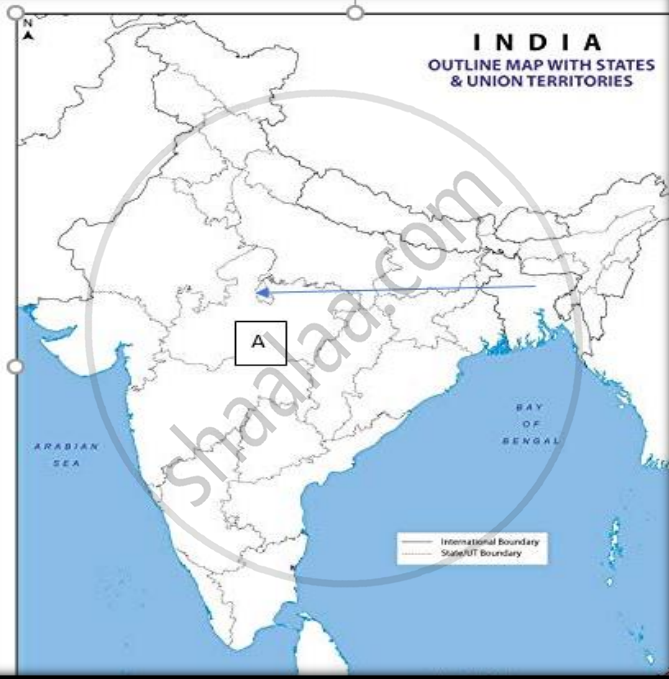
Concept: Pattern of the Rebellion
Which among the following is correctly matched?
| List I CENTRE | List II LEADER |
| A. Delhi | Nana Saheb |
| B. Kanpur | Kunwar Singh |
| C. Arrah | Bahadur Shah |
| D. Lucknow | Birjis Qadr |
Concept: Pattern of the Rebellion
Find out from the following pairs which one is NOT correctly matched:
Concept: Awadh in Revolt
Explain the main provisions of Subsidiary Alliance as devised by Lord Wellesley in 1798.
Concept: Awadh in Revolt
