Advertisements
Advertisements
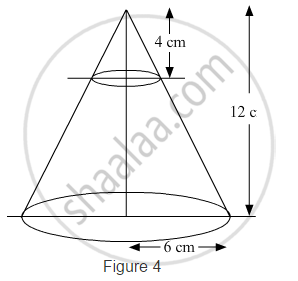
In Fig. 4, from the top of a solid cone of height 12 cm and base radius 6 cm, a cone of height 4 cm is removed by a plane parallel to the base. Find the total surface area of the remaining solid. (Use `pi=22/7` and `sqrt5=2.236`)
Concept: Surface Area of a Combination of Solids
A solid wooden toy is in the form of a hemisphere surrounded by a cone of same radius. The radius of hemisphere is 3.5 cm and the total wood used in the making of toy is 166 `5/6` cm3. Find the height of the toy. Also, find the cost of painting the hemispherical part of the toy at the rate of Rs 10 per cm2 .[Use`pi=22/7`]
Concept: Surface Area of a Combination of Solids
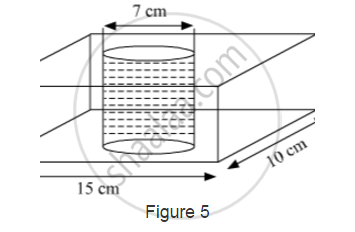
In Fig. 5, from a cuboidal solid metallic block, of dimensions 15cm ✕ 10cm ✕ 5cm, a cylindrical hole of diameter 7 cm is drilled out. Find the surface area of the remaining block [Use
`pi=22/7`]
Concept: Surface Area of a Combination of Solids
From a solid cylinder of height 2.8 cm and diameter 4.2 cm, a conical cavity of the same height and same diameter is hollowed out. Find the total surface area of the remaining solid [take π=22/7]
Concept: Surface Area of a Combination of Solids
Water in a canal, 5·4 m wide and 1·8 m deep, is flowing with a speed of 25 km/hour. How much area can it irrigate in 40 minutes, if 10 cm of standing water is required for irrigation?
Concept: Surface Area of a Combination of Solids
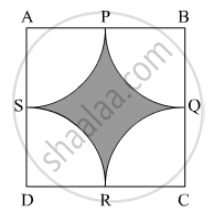
Find the area of the shaded region in Fig. 3, where arcs drawn with centres A, B, C and D intersect in pairs at mid-points P, Q, R and S of the sides AB, BC, CD and DA respectively of a square ABCD of side 12 cm. [Use π = 3.14]
Concept: Surface Area of a Combination of Solids
The diameters of the lower and upper ends of a bucket in the form of a frustum of a cone are 10 cm and 30 cm respectively. If its height is 24 cm, find:
1) The area of the metal sheet used to make the bucket.
2) Why we should avoid the bucket made by ordinary plastic? [Use π = 3.14]
Concept: Surface Area of a Combination of Solids
A vessel is in the form of hemispherical bowl surmounted by a hollow cylinder of same diameter. The diameter of the hemispherical bowl is 14 cm and the total height of the vessel is 13 cm. Find the total surface area of the vessel. `[\text{Use}pi=22/7]`
Concept: Surface Area of a Combination of Solids
The total surface area of a solid hemisphere of radius 7 cm is ______.
Concept: Surface Area of a Combination of Solids
|
Khurja is a city in the Indian state of Uttar Pradesh famous for the pottery. Khurja pottery is traditional Indian pottery work which has attracted Indians as well as foreigners with a variety of tea sets, crockery and ceramic tile works. A huge portion of the ceramics used in the country is supplied by Khurja and is also referred as "The Ceramic Town". One of the private schools of Bulandshahr organised an Educational Tour for class 10 students to Khurja. Students were very excited about the trip. Following are the few pottery objects of Khurja.
Students found the shapes of the objects very interesting and they could easily relate them with mathematical shapes viz sphere, hemisphere, cylinder etc. |
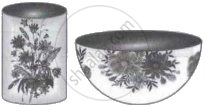

Maths teacher who was accompanying the students asked the following questions:
- The internal radius of hemispherical bowl (filled completely with water) in I is 9 cm and the radius and height of the cylindrical jar in II are 1.5 cm and 4 cm respectively. If the hemispherical bowl is to be emptied in cylindrical jars, then how many cylindrical jars are required?
- If in the cylindrical jar full of water, a conical funnel of the same height and same diameter is immersed, then how much water will flow out of the jar?
Concept: Surface Area of a Combination of Solids
The ratio of LCM and HCF of the least composite and the least prime numbers is ______.
Concept: Fundamental Theorem of Arithmetic
Show the 6n cannot end with digit 0 for any natural number 'n'.
Concept: Fundamental Theorem of Arithmetic
Find the HCF and LCM of 72 and 120.
Concept: Fundamental Theorem of Arithmetic
The LCM of smallest 2-digit number and smallest composite number is ______.
Concept: Fundamental Theorem of Arithmetic
Two numbers are in the ratio 2 : 3 and their LCM is 180. What is the HCF of these numbers?
Concept: Fundamental Theorem of Arithmetic
(HCF × LCM) for the numbers 70 and 40 is ______.
Concept: Fundamental Theorem of Arithmetic
If HCF (72, 120) = 24, then LCM (72, 120) is ______.
Concept: Fundamental Theorem of Arithmetic
Find the zeroes of the quadratic polynomial 4x2 – 4x + 1 and verify the relation between the zeroes and the coefficients.
Concept: Relation Between Zeroes (Roots) and Coefficients of a Quadratic Equation
If one zero of the quadratic polynomial x2 + 3x + k is 2, then the value of k is ______.
Concept: Geometrical Meaning of the Zeroes of a Polynomial
The number of quadratic polynomials having zeroes –5 and –3 is ______.
Concept: Geometrical Meaning of the Zeroes of a Polynomial
